The Role of Social Signals in SEO: What the Data Actually Says
Do social signals impact SEO? Explore the data-backed reality of how likes, shares, and brand mentions influence rankings and E-E-A-T in this definitive guide.
The Role of Social Signals in SEO: What the Data Actually Says
For over a decade, the SEO community has been locked in a debate: Do social signals—likes, shares, tweets, and pins—directly influence your position on the Search Engine Results Page (SERP)?
Some practitioners swear that a viral post acts as a shortcut to the top of Google. Others, citing official statements from search engines, argue that social metrics are nothing more than vanity numbers.
As an SEO educator, my goal is to move past the anecdotes and look at what the data actually tells us. In this guide, we will break down the mechanics of social signals, analyze the correlation vs. causation gap, and provide a framework for using social media to fuel your broader SEO strategy.
What Are Social Signals?
In the context of SEO, social signals refer to the collective engagement metrics a webpage receives on social media platforms. These signals act as a form of "social proof" for search engines, indicating that a piece of content is being consumed, discussed, and valued by real humans.
Common social signals include:
- Shares and Reposts: The number of times a URL is distributed across platforms like X (formerly Twitter), Facebook, and LinkedIn.
- Likes and Reactions: General sentiment indicators.
- Comments: Direct engagement and discussion surrounding the content.
- Brand Mentions: Instances where your brand name is discussed, even without a direct link.
- Social Bookmarking: Saves on platforms like Pinterest or Reddit.
According to Shopify, these signals help search engines understand audience intent and content usefulness, which are increasingly critical in an AI-driven search landscape.
The Great Debate: Direct vs. Indirect Impact
To understand the data, we must first distinguish between a direct ranking factor and an indirect influence.
1. The Direct Argument
Google has historically been vague about social signals. In 2010, they admitted social signals were a factor; by 2014, Matt Cutts famously stated that Google does not use social signals as a direct ranking signal because social data is often blocked or difficult to crawl reliably.
However, Search Engine Land notes that Bing has been more transparent, explicitly stating that social authority (the "stature" of a user) can influence how a page ranks in their web search.
2. The Indirect Reality (The "Downstream" Effect)
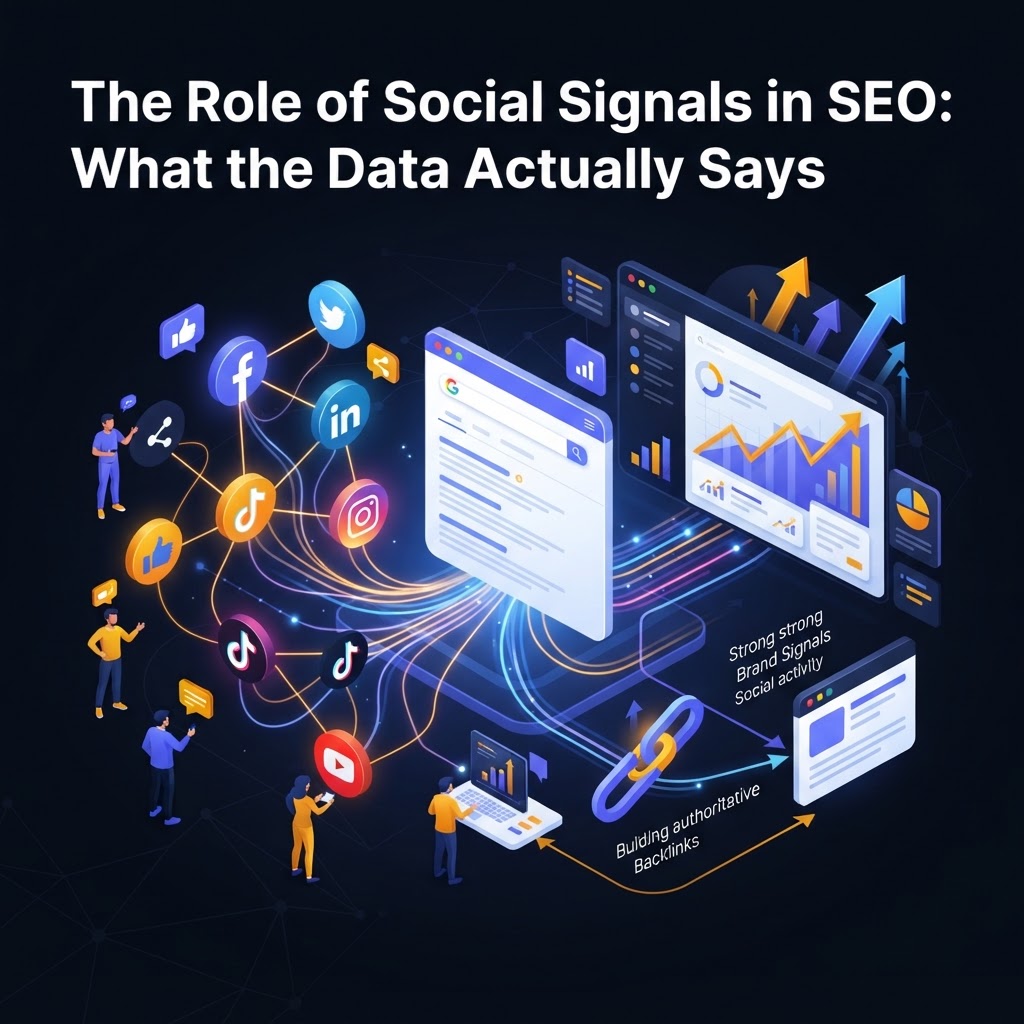
While Google may not count every "Like" as a vote of confidence, the indirect impact is undeniable. Data from Semrush and Ahrefs suggests that social signals trigger a chain reaction:
- Increased Visibility: Social sharing puts your content in front of influencers and content creators.
- Backlink Generation: When those creators see your content, they are more likely to link to it from their own websites. Backlinks are a confirmed direct ranking factor.
- Brand Searches: High social engagement leads to more people searching for your brand name on Google, which signals "Brand Authority."
What the Data Says: Key Studies
Several industry studies have attempted to quantify this relationship. Here is a summary of the most significant findings:
The Moz Correlation Study
Moz found a consistently high correlation between social shares and higher rankings. While they were careful to note that "correlation does not equal causation," the data showed that pages at the top of the SERPs almost always had a higher volume of social signals than those on page two.
The Backlinko Content Analysis
In a massive study of 912 million blog posts, Backlinko discovered that there is virtually no correlation between social shares and backlinks. This is a crucial insight: content that goes viral on social media (like entertainment or opinion pieces) is often different from content that people link to (like data-heavy research or "how-to" guides).
Takeaway: If your goal is SEO, you cannot rely on social shares alone to build your link profile. You need a dual strategy that targets both "shareable" and "linkable" content.
CognitiveSEO’s 23 Million Shares Study
CognitiveSEO analyzed 23 million social shares and found that the presence of social signals is a strong predictor of ranking success. Their data suggests that while social signals might not be the engine of SEO, they are the fuel that helps high-quality content get discovered by the algorithms.
Social Signals and E-E-A-T
In 2024 and 2025, Google’s focus has shifted heavily toward E-E-A-T (Experience, Expertise, Authoritativeness, and Trustworthiness). Social signals play a vital role in demonstrating these qualities.
- Experience: Real-world interaction on social platforms shows that a brand has a pulse and is engaging with its community.
- Authoritativeness: When industry leaders share your content, it acts as a digital citation of your authority.
- Trustworthiness: A brand with zero social presence and no mentions across the web is often viewed as less trustworthy by both users and search engines.
As OptinMonster points out, Google’s AI-powered search results now reward content that demonstrates real-world relevance and community interaction.
Actionable Strategies to Leverage Social Signals
To turn social engagement into SEO growth, you need a structured approach. Here is how to optimize your social presence for search impact:
1. Optimize for "Shareability"
Don't just post links; post value.
- Use Long Headlines: Data shows that longer headlines (14–17 words) correlate with 76% more social shares than short ones.
- Visual Assets: Infographics and original images are shared more frequently than text-only posts.
- Open Graph Tags: Ensure your site uses OG tags so that when someone shares your link, it appears with a high-quality image and a compelling meta title.
2. Build a "Link-Social" Bridge
Since social shares don't automatically lead to links, you must bridge the gap. Use social media to identify and engage with journalists, bloggers, and site owners in your niche.
For example, if you’ve published a comprehensive guide on link building, don't just tweet it. Tag the experts you cited. This increases the likelihood of them linking back to you. While tools like AAA Backlinks can help you scale your link-building efforts, social media is the perfect place for the initial "warm" outreach that makes those links possible.
3. Claim and Optimize Social Profiles
Your social media profiles often rank on the first page of Google for your brand name.
- Ensure your bio includes your target keywords.
- Link back to your website from every profile.
- Keep your NAP (Name, Address, Phone Number) consistent across all platforms to aid Local SEO.
4. Encourage "Dark Social" and Saves
Platforms like Instagram and LinkedIn now prioritize "Saves" over "Likes." A save is a high-intent signal that the content is valuable enough to return to. Create "saveable" content—checklists, cheat sheets, and deep-dive threads—to signal to the platform (and indirectly to search engines) that your content is high-utility.
Key Takeaways
- Social signals are not a direct ranking factor for Google, but they are a confirmed factor for Bing.
- Correlation is high: High-ranking pages almost always have strong social engagement.
- The impact is indirect: Social signals drive traffic, brand awareness, and the discovery of content by people who provide backlinks.
- E-E-A-T matters: Social proof helps establish your brand’s authority and trustworthiness in the eyes of search algorithms.
- Strategy is key: Focus on creating "shareable" content to drive traffic and "linkable" content to build domain authority.
Frequently Asked Questions (FAQ)
1. Do Facebook likes help my website rank higher?
Not directly. A thousand likes on a Facebook post won't automatically move your URL from position 10 to position 1. However, those likes represent traffic and visibility. If that visibility leads to other websites linking to you, your rankings will improve.
2. Should I use social media for link building?
Yes, but indirectly. Social media is a discovery tool. It allows you to get your content in front of the people who have the power to give you editorial backlinks. It is the "top of the funnel" for a successful link-building strategy.
3. Which social platform is best for SEO?
It depends on your niche. LinkedIn is excellent for B2B and establishing professional authority. Pinterest is a powerhouse for visual niches and long-term referral traffic. X (Twitter) is the fastest way to get content indexed and seen by journalists and news outlets.
Tags