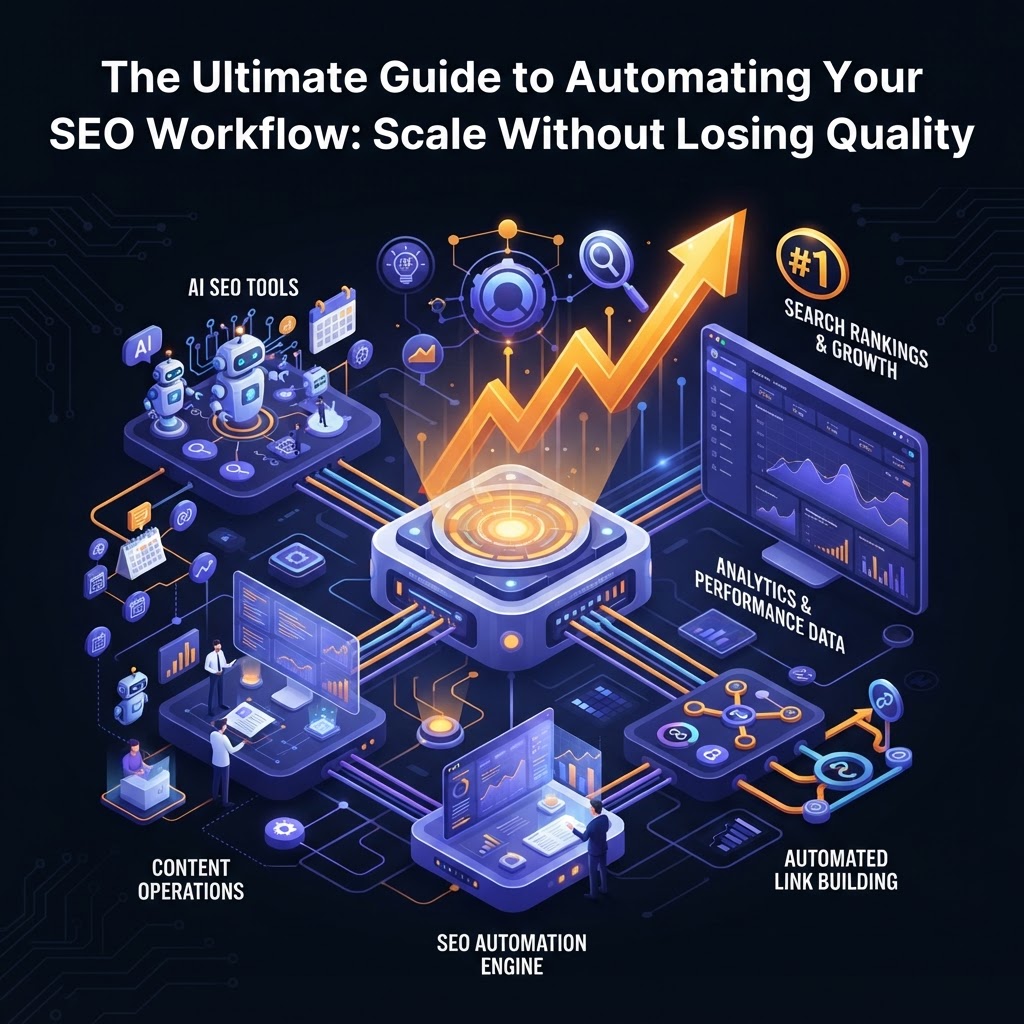
The Ultimate Guide to Automating Your SEO Workflow: Scale Without Losing Quality
Master SEO automation in 2026. Learn how to automate keyword research, content briefs, technical audits, and link building to save hundreds of hours per year.
The Ultimate Guide to Automating Your SEO Workflow: Scale Without Losing Quality
In the early days of search engine optimization, a "workflow" consisted of manual spreadsheets, hand-written meta descriptions, and the tedious process of checking rankings one by one. Today, that approach isn't just inefficient—it’s a competitive liability.
Industry data suggests that a single SEO account can lose up to 327 hours per year to manual, repetitive tasks. For agencies or enterprise teams, this inefficiency scales into thousands of lost hours that could be spent on high-level strategy and creative experimentation.
SEO automation is the practice of using software, APIs, and AI models to handle repeatable tasks, allowing you to focus on the "human" elements of SEO: strategy, editorial judgment, and brand positioning. This guide will walk you through the definitive framework for automating your entire SEO lifecycle.
1. The Framework: What to Automate (and What to Protect)
Before you build a single automation, you must distinguish between execution and decision-making. Automation is a machine that runs your SEO; you are the operator.
The Automation Matrix
According to industry insights, most successful teams automate tasks that meet three criteria:
- High Data Volume: Auditing 50,000 URLs for redirect chains.
- Rule-Based Logic: Flagging pages that are missing meta descriptions.
- Scheduled Repetition: Pulling rank tracking reports every Monday morning.
What to Automate:
- Keyword research and clustering.
- Technical site audits and uptime monitoring.
- Content brief generation.
- Internal link discovery and deployment.
- Reporting and data visualization.
What to Keep Human:
- Final content editing for brand voice and E-E-A-T.
- High-level keyword prioritization based on business goals.
- Relationship building for PR-driven backlinks.
2. Automating Keyword Research and Topic Clustering
Keyword research is no longer about finding a single high-volume term; it’s about understanding topical authority. Approximately 84% of SEO professionals now automate at least part of their keyword research.
The Workflow:
- Seed Extraction: Use tools like Ahrefs or Semrush APIs to pull thousands of related terms for a seed topic.
- AI Clustering: Instead of manual grouping, use LLMs (like Claude or GPT-4) to cluster keywords by Search Intent. For example, you can feed a list of 500 keywords into a script that categorizes them into "Informational," "Commercial," or "Transactional."
- Gap Analysis: Automate the discovery of keywords your competitors rank for but you don't. Tools like SearchAtlas allow you to set up recurring "Content Gap" alerts that notify you when a competitor gains a new ranking in your niche.
3. Content Operations: From Briefs to Scaffolding
Content creation is often the biggest bottleneck. While you should never fully automate the writing of your articles (to maintain quality and E-E-A-T), you can automate the "scaffolding" that supports the writer.
The Automated Content Brief
Instead of spending 30 minutes researching the SERP for every new post, build a workflow using tools like Make.com or Zapier:
- Step 1: Trigger the workflow when a new keyword is added to a Google Sheet.
- Step 2: Use an SEO tool API to pull the top 10 ranking URLs and their headers (H1-H3).
- Step 3: Use an AI model to summarize the common themes, suggest a target word count, and list frequently asked questions from "People Also Ask."
- Step 4: Deliver a complete brief to your writer in Slack or Notion.
This process saves roughly 10 to 15 minutes per page, allowing your editorial team to focus purely on the quality of the prose.
4. Technical SEO: Real-Time Monitoring and Audits
Technical SEO is perfectly suited for automation because it relies on binary rules (e.g., a page is either indexable or it isn't).
Automated Site Health Checks
Rather than running a manual audit once a month, set up automated monitoring:
- Custom Scanners: Use tools like ContentKing or Little Warden to monitor your site 24/7. If a developer accidentally adds a
noindextag to a high-traffic page, you receive an alert in seconds, not weeks. - Schema Generation: Use AI agents to generate structured data (JSON-LD) for your articles, products, or FAQs. This ensures your site is always ready for rich snippets without manual coding.
- Log File Analysis: Automate the collection of server logs to see exactly how Googlebot is crawling your site, identifying crawl budget waste in real-time.
5. Automating Link Building and Internal Linking
Link building is traditionally the most manual part of SEO, but modern tools have introduced significant efficiencies in both external and internal link management.
Internal Link Automation
Internal links distribute PageRank and help Google understand your site structure. Manually finding relevant anchor text across thousands of pages is nearly impossible. Tools like the AAA Backlinks AI Internal Link Engine use semantic NLP to analyze your content and automatically suggest or insert relevant internal links, ensuring your "pillar" pages receive the most authority.
Backlink Monitoring
Automate the tracking of your backlink profile to protect your hard-earned authority. Set up alerts for:
- Lost Backlinks: Automatically reach out to webmasters when a high-value link disappears.
- Toxic Spikes: Monitor for negative SEO attacks or sudden influxes of low-quality links that may require a disavow file (though this is increasingly rare in 2026).
- Competitor Mentions: Use tools like Brand24 or Google Alerts to find where competitors are being mentioned and reach out to those same sources for your own placements.
6. Reporting: Moving to Live Dashboards
If you are still building PDF reports by hand at the end of the month, you are wasting time. Modern SEO reporting should be dynamic and automated.
The Modern Stack:
- Google Looker Studio: Connect your Search Console, GA4, and rank tracking data into a single, live dashboard.
- Automated Slack Alerts: Set up triggers for significant events, such as a 10% drop in organic traffic or a keyword entering the Top 3 positions.
- API Integration: Use Python or tools like n8n to pull data from multiple sources into a centralized data warehouse (like BigQuery) for advanced trend analysis.
Key Takeaways
- Start Small: Don't try to automate everything at once. Begin with the most repetitive tasks, like rank tracking and technical alerts.
- Human-in-the-Loop: Always maintain a human layer for quality control, especially in content creation and high-level strategy.
- Use the Right Stack: Combine all-in-one platforms like Ahrefs or Semrush with orchestration tools like Make.com and specialized AI tools like AAA Backlinks for link management.
- Focus on Intent: Use AI to cluster keywords by intent rather than just volume to build more effective content silos.
Frequently Asked Questions
Q: Will SEO automation get my site penalized by Google?
A: No, as long as you aren't using it to generate low-quality, mass-produced content. Google penalizes "spammy" behavior, not efficiency. Using automation for technical audits, internal linking, and data analysis is considered a best practice.
Q: Do I need to know how to code to automate my SEO?
A: While Python is helpful for custom scripts, "no-code" tools like Zapier, Make.com, and n8n allow you to build complex SEO workflows using visual interfaces and APIs.
Q: What is the most important SEO task to automate first?
A: Technical monitoring and site health alerts. These protect your existing rankings from accidental errors, providing the highest immediate ROI on your time.
Tags