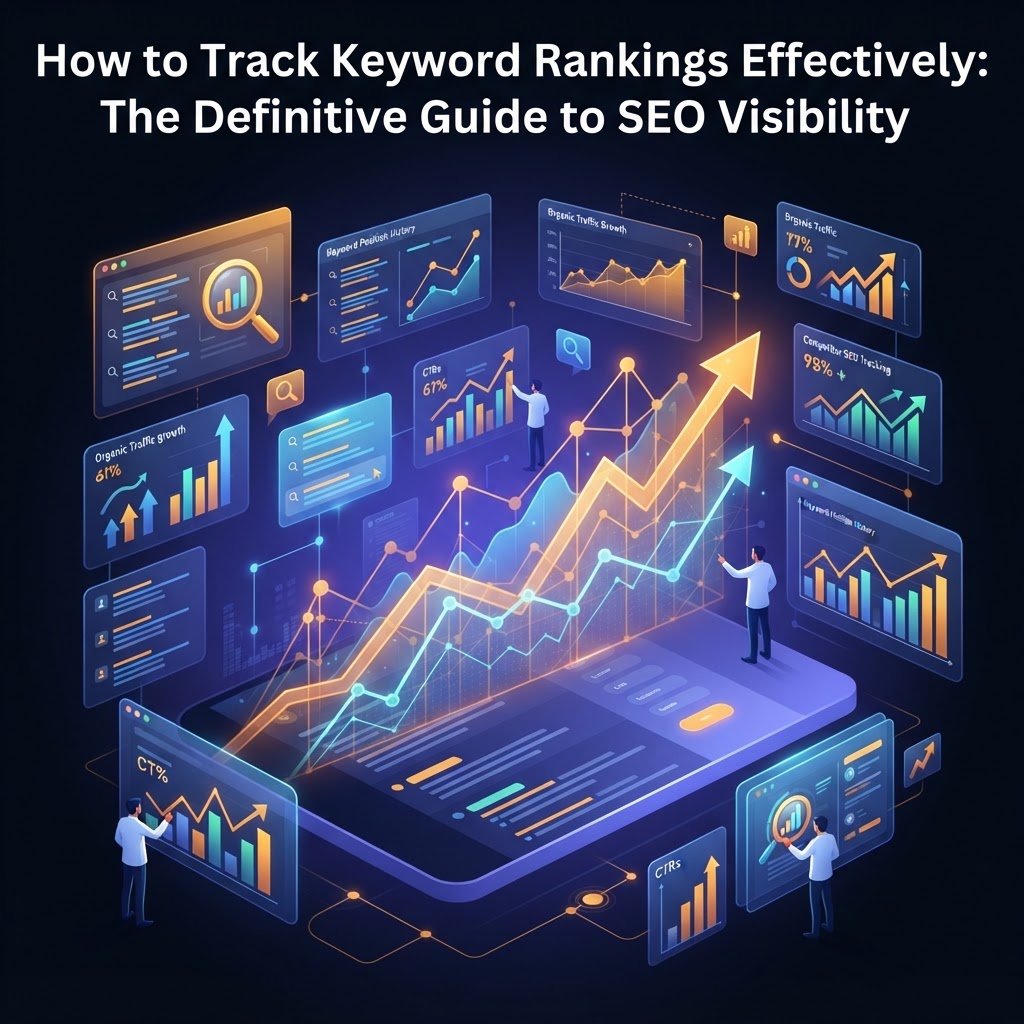
How to Track Keyword Rankings Effectively: The Definitive Guide to SEO Visibility
Learn how to track keyword rankings with precision. Master SERP volatility, analyze competitor moves, and turn ranking data into actionable SEO growth strategies.
How to Track Keyword Rankings Effectively: The Definitive Guide to SEO Visibility
In the world of digital marketing, operating without rank tracking is like a pilot flying without instruments. You might feel like you’re moving, but you have no idea if you’re heading toward your destination or drifting off course.
Keyword rank tracking is the process of monitoring the positions of your website’s pages for specific search queries over time. While organic traffic is the ultimate goal, ranking data is the leading indicator that tells you why that traffic is rising or falling.
According to industry data, a page that slips from position 3 to position 8 can lose up to 60% of its traffic overnight. If you aren't tracking your rankings effectively, you won't notice the slide until your revenue takes a hit.
This guide will move beyond basic "position checking" to show you how to build a sophisticated tracking strategy that drives actual business growth.
Why Rank Tracking is More Than a Vanity Metric
Many SEOs dismiss rank tracking as a "vanity metric" because Google’s results are increasingly personalized. However, effective tracking provides three critical insights that traffic data alone cannot:
- Algorithm Impact Analysis: When Google releases a Core Update, rank tracking helps you identify exactly which clusters of keywords were affected, allowing for surgical content fixes.
- Competitor Intelligence: By benchmarking your site against rivals, you can spot domains sneaking up the rankings and reverse-engineer their strategy before they overtake you.
- Identifying "Striking Distance" Opportunities: Keywords ranking in positions 11–20 (Page 2) are high-leverage targets. A small optimization or a few high-quality backlinks can push these into the top 10, resulting in a massive traffic lift.
Step 1: Selecting the Right Keywords to Track
You cannot (and should not) track every single keyword your site ranks for. Tracking thousands of irrelevant terms creates noise that masks important trends. Instead, categorize your keywords into three buckets:
1. Money Keywords
These are high-intent, bottom-of-the-funnel terms that directly drive conversions. For an e-commerce site, this might be "buy organic coffee beans"; for a SaaS, it’s "best project management software."
2. Informational Pillars
These are high-volume, top-of-the-funnel terms that establish your authority. They might not convert immediately, but they feed your remarketing lists and build brand awareness.
3. Branded Keywords
Monitoring your own brand name is essential for reputation management. If a competitor or a negative review starts outranking your homepage for your brand name, you need to know immediately.
Step 2: Choosing Your Tracking Toolkit
To track effectively, you need a mix of first-party data and third-party tools.
- Google Search Console (GSC): The "source of truth." It provides actual click and impression data directly from Google. However, it is often delayed by 48 hours and doesn't show competitor data.
- Professional Rank Trackers: Tools like Ahrefs and Semrush offer daily updates, competitor benchmarking, and SERP feature tracking.
- AI-Powered Automation: For agencies managing multiple campaigns, platforms like AAA Backlinks provide automated SEO engines that help track rankings while simultaneously scaling the backlink strategies needed to improve them.
Step 3: Advanced Tracking Strategies
Effective tracking isn't just about a single number; it’s about context. Use these advanced strategies to gain a deeper understanding of your visibility.
Segmentation and Tagging
Don't look at your average position as a whole. Segment your keywords by:
- Product Category: (e.g., "Shoes" vs. "Hats")
- User Intent: (Informational, Commercial, Transactional)
- Content Type: (Blog posts vs. Service pages)
Monitoring SERP Features
Modern SEO is no longer just about the "10 blue links." You must track your visibility in SERP features such as:
- AI Overviews: Are you being cited in Google’s AI-generated answers?
- Featured Snippets: Are you capturing the "Position 0" spot?
- Local Packs: For local businesses, tracking rankings by ZIP code is vital.
Mobile vs. Desktop Parity
Google uses mobile-first indexing. If your mobile rankings are significantly lower than your desktop rankings, it’s a red flag for technical SEO issues or poor mobile user experience.
Step 4: Analyzing Volatility and Cannibalization
When you see a ranking drop, don't panic. Analyze the cause first.
- SERP Volatility: Use tools to check if the entire industry is shifting. If everyone is dropping, it’s likely an algorithm update. If only you are dropping, it’s a site-specific issue.
- Keyword Cannibalization: If you see two different URLs from your site constantly swapping positions for the same keyword, you have a cannibalization issue. Google is confused about which page is the best fit, often resulting in both pages ranking lower than a single, authoritative page would.
Step 5: Turning Data into Action
Rank tracking is useless if it doesn't lead to action. Create a workflow based on your findings:
- If a keyword is in positions 11-20: Perform a content refresh. Add updated data, new images, or improve the internal linking structure.
- If a keyword drops from the top 3: Check the competitor who replaced you. Did they add more depth? Did they gain new high-authority backlinks? Use a tool like AAA Backlinks to analyze your link gap and build the necessary authority to reclaim your spot.
- If search intent shifts: Sometimes Google decides a query that used to be informational is now commercial. If your blog post drops, you may need to create a product comparison page to match the new intent.
Key Takeaways
- Focus on Quality: Track keywords that align with business goals, not just high-volume vanity terms.
- Context is King: Use segmentation to understand which parts of your site are winning or losing.
- Watch the SERP: Track AI Overviews and Featured Snippets, as these often steal clicks from the top organic positions.
- Automate Where Possible: Use professional tools to handle the daily monitoring so you can focus on strategy and execution.
FAQ
Q: How often should I check my keyword rankings?
A: For most businesses, a weekly check is sufficient. However, during a major site migration or a Google Core Update, daily monitoring is recommended to catch and react to volatility quickly.
Q: Why does my rank tracker show a different position than what I see on Google?
A: Google personalizes results based on your location, search history, and device. Rank trackers typically use "clean" browsers and specific IP addresses to provide a standardized, non-personalized view of the SERP.
Q: Is a drop in rankings always a bad sign?
A: Not necessarily. If you lose rankings for a keyword with the wrong search intent (e.g., people looking for a free tool when you sell a premium service), your traffic might drop, but your conversion rate could actually improve as you attract more qualified leads.
Tags