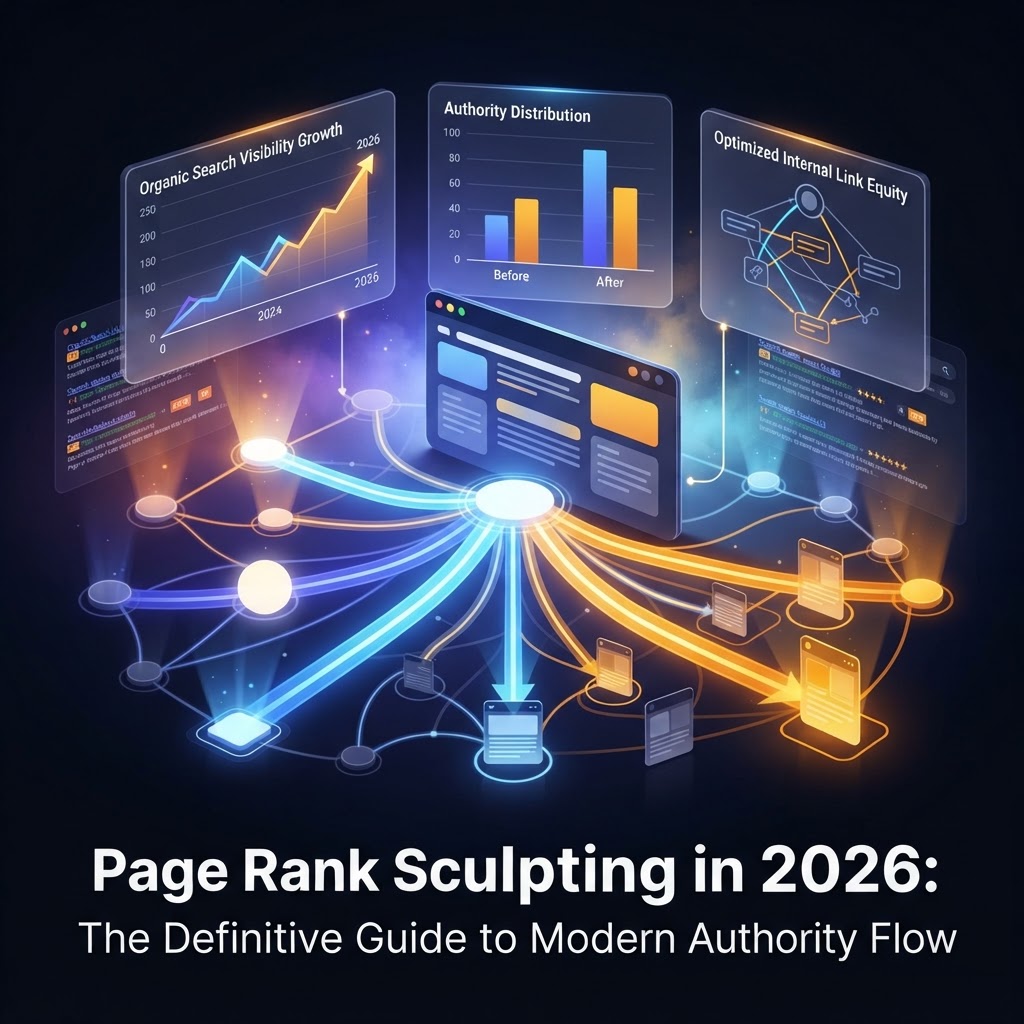
Page Rank Sculpting in 2026: The Definitive Guide to Modern Authority Flow
Is PageRank sculpting still relevant? Learn how to strategically distribute link equity in 2026 using site architecture and internal linking, not nofollow tags.
Page Rank Sculpting in 2026: The Definitive Guide to Modern Authority Flow
In the early days of SEO, PageRank sculpting was the digital equivalent of plumbing. Webmasters used the rel="nofollow" tag like a shut-off valve, stopping "link juice" from flowing to "unimportant" pages like "Contact Us" or "Privacy Policy" to force more authority toward their money pages.
Then, in 2009, Google changed the math. The valve didn't just redirect the flow; it started leaking.
Fast forward to 2026, and the SEO community is still divided. Some claim PageRank is a relic of the past, while others obsess over every internal link. As an expert strategist at AAA Backlinks, I’m here to tell you the truth: PageRank sculpting is not dead, but the way you do it has fundamentally changed.
In this guide, we will explore why authority flow matters more than ever in the age of AI-driven search and how to architect your site for maximum ranking power.
Does PageRank Still Exist in 2026?
Before we talk about sculpting, we must address the elephant in the room: Does Google still use PageRank?
Yes. While the public PageRank toolbar was retired years ago, internal Google documentation and recent API leaks confirm that systems like PageRankPerDocData and sitePr remain foundational to how Google evaluates the web.
In 2026, PageRank serves three primary functions:
- Crawl Prioritization: High-authority pages are crawled more frequently (often every 24 hours) compared to low-authority pages.
- Quality Thresholds: Signals like
csePagerankCutoffact as a gatekeeper for inclusion in premium search features. - Indexing Triage: In an era of infinite AI-generated content, Google uses PageRank to decide which pages are worth the computing cost of indexing.
The Death of the "Nofollow" Sculpting Tactic
If you are still using rel="nofollow" on internal links to "save" PageRank, you are making a critical mistake.
Historically, if a page had 10 points of PageRank and 10 links, each link passed 1 point. SEOs thought that by nofollowing 5 links, the remaining 5 would get 2 points each.
Google’s 2009 update changed this: If you nofollow 5 out of 10 links, the 5 "dofollow" links still only get 1 point each. The other 5 points simply evaporate into the void.
In 2026, Google treats nofollow as a "hint" rather than a directive. Using it internally doesn't help you rank; it only hinders Google’s ability to understand your site’s relationship graph.
Modern PageRank Sculpting: The Architecture Approach
Modern sculpting isn't about blocking flow; it’s about directing it through smart architecture. Here is how to strategically manage your link equity today.
1. The 3-Click Rule and Flat Architecture
Data from industry studies suggests that pages located more than three clicks away from the homepage struggle to maintain high rankings. This is because PageRank dilutes with every "hop" it takes from the primary authority source (usually the homepage).
- Actionable Strategy: Use a "Mega Menu" or a robust HTML sitemap in the footer to ensure your most important category pages are only one click away from the root.
2. The Pillar-and-Cluster Model
Instead of haphazardly linking, use a hub-and-spoke model.
- The Pillar: A comprehensive guide on a broad topic.
- The Clusters: Specific articles answering niche questions related to the pillar.
By linking all cluster content back to the pillar, and the pillar to each cluster, you create a self-sustaining "authority loop." This signals to Google that the entire group of pages is a topical powerhouse.
3. Managing "Dangling Links"
A dangling link is a link to a page that has no outgoing links (like a PDF or a "Thank You" page). In the PageRank algorithm, these act as "sinks" where authority gets trapped.
- Actionable Strategy: Ensure every page on your site—including utility pages—has at least one path back to a major hub or the homepage. This keeps the "random surfer" (and Googlebot) moving through your ecosystem.
4. Strategic Homepage Real Estate
Your homepage is likely your most authoritative page. Every link on your homepage is a high-powered endorsement.
- Don't waste it: Avoid linking to low-value pages (like "Login") directly from the homepage body.
- Do prioritize: Link to your highest-converting services or your most important current content assets. As Matt Cutts famously noted, choosing which pages to link to from your homepage is the most effective form of PageRank sculpting.
The Role of External Backlinks in Sculpting
You cannot sculpt what you do not have. Internal linking only redistributes existing authority; it doesn't create it.
To make sculpting effective, you need a steady influx of external link equity. When you earn a high-quality backlink to a specific blog post, that post becomes a "mini-homepage." You should then immediately "sculpt" that new authority by adding internal links from that post to your commercial pages.
Tools like AAA Backlinks or Ahrefs can help you identify which of your pages have the most external equity, allowing you to use them as strategic jumping-off points for internal distribution.
Data-Backed Insights: Why It Matters Now
- Crawl Efficiency: Sites with optimized internal structures see a 20-30% increase in crawl frequency for deep-linked pages.
- Topical Authority: Google’s Helpful Content System (HCS) rewards sites that demonstrate a clear hierarchy. Sculpting via clusters helps prove this hierarchy.
- Link Decay: In 2026, "link rot" is a major issue. Regular audits to remove internal links to 404 pages are essential to prevent PageRank leakage.
Key Takeaways for 2026
- Stop using Nofollow internally: It wastes authority rather than redistributing it.
- Focus on Click Depth: Keep your "money pages" within 3 clicks of the homepage.
- Use Hubs: Group related content to create topical authority loops.
- Audit Sinks: Don't let PageRank die on pages with no outgoing links.
- External Input: Sculpting is only effective if you are actively building new authority through external link building.
Frequently Asked Questions
1. Does having too many links on a page dilute PageRank?
Yes. PageRank is divided among all outgoing links on a page. If a page has 200 links, each link passes significantly less authority than if the page had only 10 links. Aim for a balance between user experience and link density.
2. Should I link to my "Contact" and "About" pages in the main navigation?
Yes. While these aren't "ranking" pages, they are vital for E-E-A-T (Experience, Expertise, Authoritativeness, and Trustworthiness). Google needs to see these pages to verify your legitimacy. The small amount of PageRank they "consume" is worth the trust signal they provide.
3. Can I use JavaScript links to hide links from Google?
In 2026, Google is highly proficient at rendering JavaScript. Attempting to "hide" links to sculpt PageRank is often viewed as a manipulative tactic and rarely works. Stick to a clean, crawlable HTML structure for the best results.
Tags