The Ultimate Guide to Building Topical Authority with Content Clusters
Master the art of topical authority. Learn how to structure content clusters, pillar pages, and internal links to dominate search rankings and build E-E-A-T.
The Ultimate Guide to Building Topical Authority with Content Clusters
In the early days of SEO, ranking was a game of individual keywords. You wrote a post for "best running shoes," another for "running shoes for flat feet," and hoped for the best. Today, search engines have evolved. Google no longer just looks for keywords; it looks for topical authority.
Topical authority is the measure of a website's perceived expertise and depth on a specific subject. According to Ahrefs, building this authority comes down to two main pillars: exhaustive keyword research and organized topic clusters.
This guide will walk you through the exact framework for building topical authority using content clusters, transforming your site from a collection of random posts into a definitive industry resource.
What is Topical Authority (and Why Does It Matter?)
Topical authority is a search engine optimization concept where a website aims to be the go-to resource for one or more broad topics. Instead of ranking for a single high-volume term, you aim to own the entire conversation around that term.
The Shift from Keywords to Entities
Since the Hummingbird update and the rise of E-E-A-T (Experience, Expertise, Authoritativeness, and Trustworthiness), Google uses semantic search to understand the relationship between different concepts. When you cover a topic from every possible angle, you signal to search engines that you are a trusted expert.
The benefits are clear:
- Higher Rankings: Google prefers to rank sites that demonstrate deep knowledge.
- Increased Trust: Users are more likely to convert when they see you have answered all their related questions.
- Better Internal Link Equity: Clusters allow link juice to flow naturally between related pages.
The Anatomy of a Content Cluster
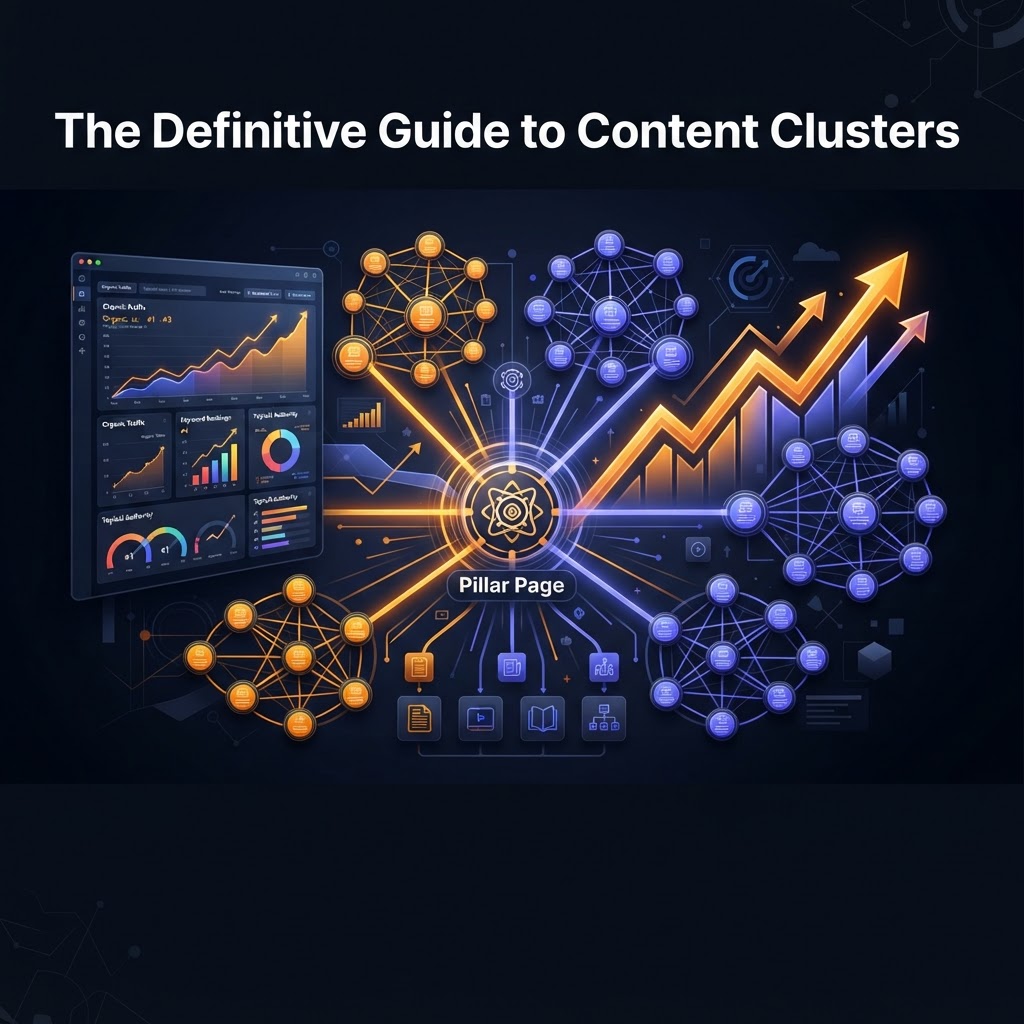
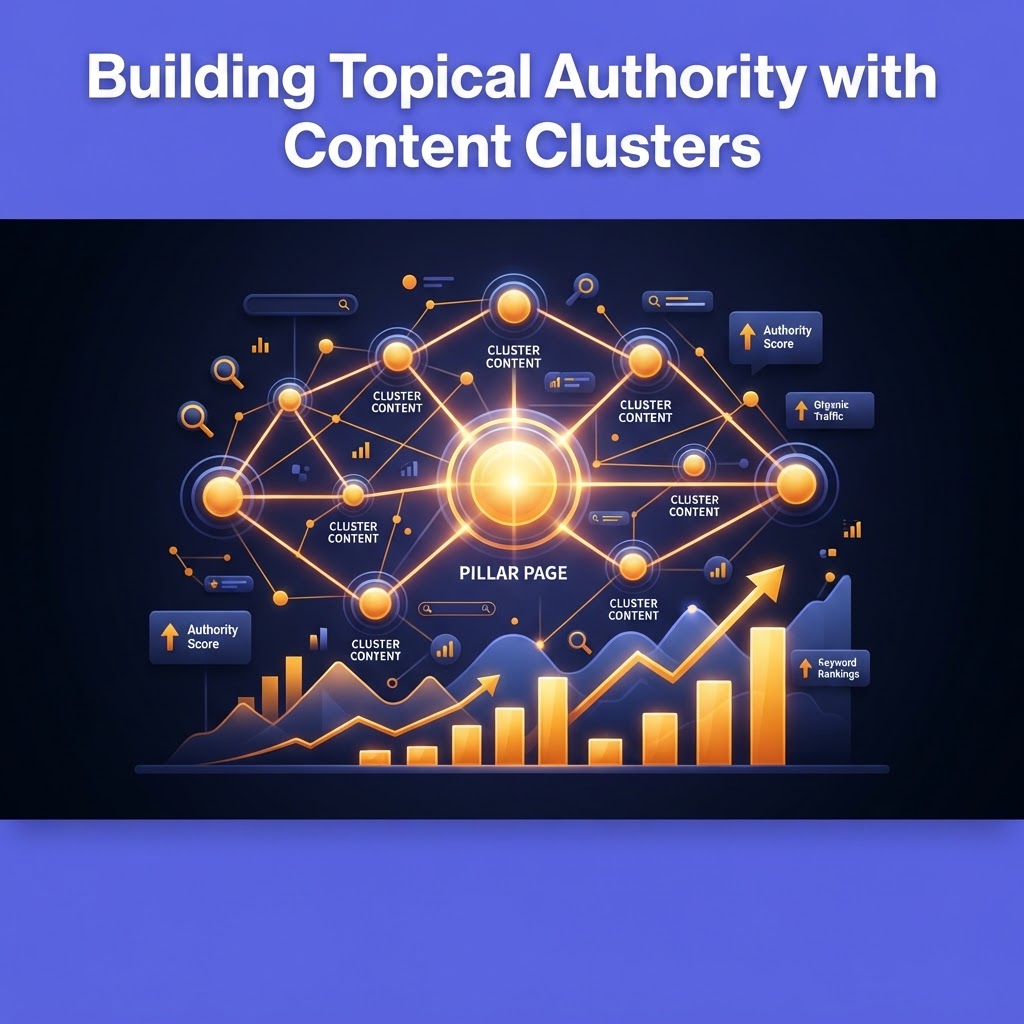
A content cluster (or topic cluster) is a structural framework designed to organize your website’s content. It consists of three main components:
- The Pillar Page: A comprehensive, high-level guide on a broad topic (e.g., "The Complete Guide to SEO Strategy").
- Cluster Pages (Satellites): In-depth articles that focus on specific subtopics mentioned in the pillar (e.g., "How to Use Long-Tail Keywords" or "Building Backlinks").
- Internal Links: The "connective tissue" that links the pillar to the clusters and vice versa.
As noted by Yoast, this structure makes the relationship between your pages explicit to search engines, reinforcing your site's comprehensive coverage.
Step 1: Identifying Your Core Pillar Topics
Before you start writing, you must choose the right "seed" topics. A pillar topic should be broad enough to spawn at least 10–20 subtopics but specific enough to be relevant to your business goals.
How to Choose a Pillar Topic:
- Business Alignment: What products or services do you offer? What do you want to be known for? Machined.ai suggests starting with industry pain points or common customer questions.
- Search Volume vs. Intent: Look for "head terms" with significant search volume that represent the start of a buyer's journey.
- Example: If you run a fitness site, "Marathon Training" is a great pillar. "Best Laces for Running Shoes" is too narrow.
Step 2: Mapping the Cluster (Subtopics)
Once you have your pillar, you need to identify the "satellites." The goal is to cover the depth and breadth of the topic to avoid leaving any "information gaps."
Actionable Strategy: The "Search Intent" Map
Use tools like Semrush, Ahrefs, or even the automated content engines at AAA Backlinks to identify related keywords. Look for:
- Informational Intent: "How to start running?"
- Transactional Intent: "Best marathon running shoes."
- Comparative Intent: "Marathon vs. Half-Marathon training load."
According to Backlinko, a successful cluster often includes 101-level resources for beginners and advanced guides for experienced users.
Step 3: Executing the Internal Linking Strategy
Internal linking is the most critical—and often most neglected—part of building topical authority. It acts as the central nervous system of your cluster Sedestral.
The Golden Rules of Cluster Linking:
- Pillar to Cluster: The pillar page should link out to every cluster page.
- Cluster to Pillar: Every cluster page must link back to the pillar page using descriptive, keyword-rich anchor text ContentGrip.
- Cluster to Cluster: If two subtopics are related (e.g., "Nutrition for Runners" and "Hydration for Runners"), link them together to create a dense semantic web.
Pro Tip: Avoid generic anchor text like "click here." Instead, use "our guide to marathon nutrition" to pass maximum relevance signals to Google.
Step 4: Avoiding Keyword Cannibalization
One of the biggest risks in building large clusters is keyword cannibalization—when two or more pages on your site compete for the same keyword. This confuses search engines and dilutes your ranking power Spicy Margarita.
How to Prevent It:
- Assign One Primary Keyword per Page: Ensure every cluster page has a unique focus.
- Audit Regularly: If you find two pages ranking for the same term, consolidate them into one "super-page" or differentiate their intent (e.g., one for beginners, one for pros).
Real-World Example: The "SEO Strategy" Cluster
Imagine you are building authority for the topic "SEO Strategy." Your cluster might look like this:
- Pillar Page: The Definitive Guide to SEO Strategy in 2026.
- Cluster Page 1: How to conduct a technical SEO audit.
- Cluster Page 2: A beginner's guide to keyword research.
- Cluster Page 3: Anchor text optimization strategies.
- Cluster Page 4: The role of backlinks in modern SEO.
- Cluster Page 5: How to measure SEO ROI.
By connecting these, you tell Google: "We don't just know one thing about SEO; we know everything about SEO."
Key Takeaways for SEO Success
- Focus on Topics, Not Just Keywords: Build depth by answering every related question a user might have.
- Structure Matters: Use the Pillar-Cluster model to organize your site's architecture.
- Link Strategically: Use contextual, descriptive anchor text to connect your content.
- Quality Over Quantity: One comprehensive, well-linked cluster is better than 50 disconnected blog posts.
- Scale with Tools: Use platforms like AAA Backlinks to help manage and scale your content and backlink strategies as your clusters grow.
Frequently Asked Questions (FAQ)
1. How many cluster pages do I need for one pillar? There is no magic number, but most experts recommend at least 5 to 10 cluster pages to start seeing a "topical authority" effect. For highly competitive topics, you may need 20 or more.
2. Can one page belong to two different clusters? Yes, but be careful. While a page on "Content Marketing" could link to both an "SEO" pillar and a "Digital Marketing" pillar, ensure the primary internal link points to the most relevant parent topic to avoid confusing search engines.
3. How long does it take to build topical authority? Topical authority is a long-term play. Depending on the competition and your publishing frequency, it typically takes 3 to 6 months of consistent clustering and interlinking to see significant movement in rankings.
Tags