Mastering Topical Authority: The Definitive Guide to Content Clusters
Learn how to build topical authority using content clusters. This comprehensive guide covers pillar pages, internal linking, and semantic SEO strategies for 2025.
Mastering Topical Authority: The Definitive Guide to Content Clusters
In the early days of SEO, ranking was a game of individual keywords. You wrote a post for "best running shoes," optimized the meta tags, built a few links, and hoped for the best. Today, the landscape has shifted fundamentally. Google no longer just looks at what a single page says; it looks at what your entire website knows.
This shift is defined by Topical Authority.
Topical authority is an SEO concept where a website aims to become the go-to resource for one or more specific subjects Topical Authority: What It Is, How Google Measures It, and How to Build It. To achieve this, SEOs use Content Clusters—a strategic framework designed to demonstrate depth, breadth, and expertise to search engines.
In this guide, we will break down the mechanics of content clusters and provide a step-by-step roadmap to building authority that lasts.
What is a Content Cluster?
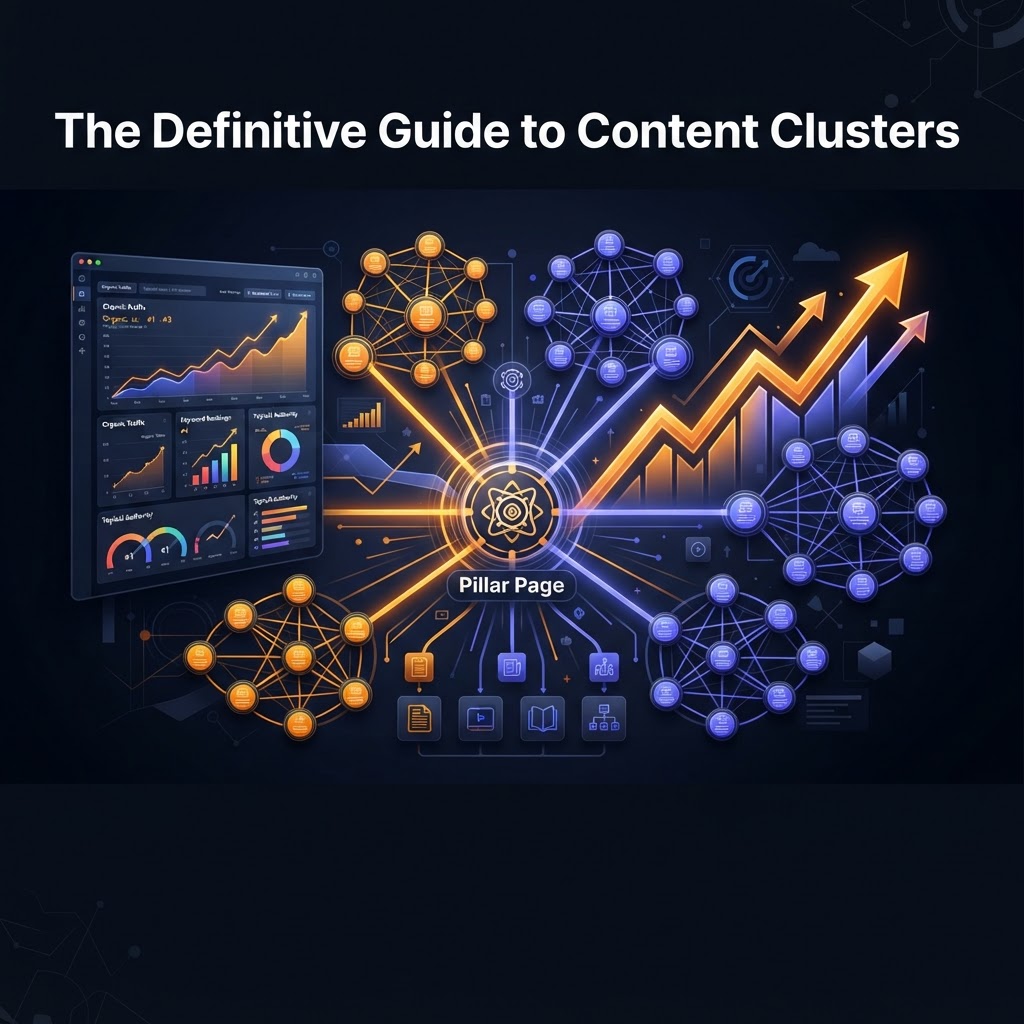
A content cluster (or topic cluster) is a group of interlinked pages centered around a single, broad topic. It consists of three main components:
- The Pillar Page: A comprehensive, high-level guide covering a broad topic (e.g., "The Ultimate Guide to Marathon Training").
- Cluster Pages: Specific, in-depth articles that address subtopics or long-tail queries related to the pillar (e.g., "Best Nutrition for Marathon Runners" or "How to Choose Marathon Shoes").
- Internal Links: The "connective tissue" that links cluster pages back to the pillar and, ideally, to each other Content clusters: What are they and do you need them?.
This structure creates a "hub-and-spoke" model that helps search engines map your expertise across both head terms and long-tail queries Pillar and Cluster Content: Build Topical Authority Fast.
Why Topical Authority is the New SEO Currency
Search engines have evolved through updates like Hummingbird and Penguin to prioritize semantic relevance and quality over keyword density How to Earn Topical Authority in 2023 and Beyond - Moz.
The Benefits of a Cluster Strategy:
- Improved Rankings: Mature clusters can drive 2-3x more organic traffic than isolated articles because they signal comprehensive coverage to Google Content Clusters & Internal Linking for SEO (2026).
- Semantic SEO: By covering every facet of a topic, you help search engines understand the context and meaning of your content Topical Authority: What It Is, How Google Measures It, and How to Build It.
- Enhanced User Experience: Clusters create natural pathways for readers, helping them find answers to questions they didn't even know they had Content Clusters: The Complete Guide to Building Topical Authority | Machined.
- Link Equity Distribution: When one page in the cluster earns a high-quality backlink, the internal linking structure helps distribute that "authority" to all other pages in the group.
Step 1: Identifying Your "Seed" Topics
Before you write a single word, you must identify the topics you want to own. A common mistake is choosing topics that are too narrow.
- Bad Example: "Nike Air Zoom Pegasus 38 Review" (Too specific for a pillar).
- Good Example: "Running Shoes" (Broad enough to support dozens of subtopics) SEO Topic Clusters: The Ultimate Guide to Topical Authority [2026] - TrueRanker.
Actionable Strategy: Align your topics with your business goals. Ask yourself: What are the core problems our product or service solves? What are the industry pain points we can address? Content Clusters: The Complete Guide to Building Topical Authority | Machined.
Step 2: Mapping the Cluster with Keyword Research
Once you have a seed topic, you need to find the "spokes." Use tools like Ahrefs, Semrush, or AAA Backlinks to identify long-tail keywords and common questions What is Topical Authority? (+ How to Build It) Semrush.
Look for:
- Informational Intent: "How to...", "What is..."
- Comparative Intent: "X vs Y", "Best tools for..."
- Transactional Intent: "Buy...", "Pricing for..."
Pro Tip: Use the "People Also Ask" section on Google to find real-world questions your audience is searching for. Each of these questions can potentially become a cluster page.
Step 3: Creating the Pillar Page
Your pillar page is the foundation. It should be a high-level overview that touches on every subtopic within the cluster without going into exhaustive detail on any single one.
- Length: Typically 2,000+ words.
- Structure: Use clear H2 and H3 headings to organize the subtopics The complete guide to topic clusters and pillar pages for SEO.
- Value: It should educate rather than sell. The goal is to make the reader feel informed enough to explore your more specialized content Topic cluster strategy guide: master pillar pages for SEO.
Step 4: Developing Cluster Content
Cluster pages are where you dive deep. Each page should focus on a single long-tail keyword or specific user intent Topic cluster strategy guide: master pillar pages for SEO.
For a "Running Shoes" pillar, your cluster pages might include:
- How to choose shoes for flat feet.
- The difference between trail and road running shoes.
- When to replace your running shoes.
- A review of the top 10 marathon shoes for 2025.
Original Insight: Don't just rewrite what's already out there. Search engines reward "Information Gain." Add original data, case studies, or unique expert perspectives to ensure your content offers something competitors can't match What is Topical Authority? (+ How to Build It) Semrush.
Step 5: The Golden Rule of Internal Linking
Internal linking is what transforms a collection of articles into a cluster.
- Cluster to Pillar: Every cluster page must link back to the pillar page using descriptive anchor text Topical Authority: What It Is, How Google Measures It, and How to Build It.
- Pillar to Cluster: The pillar page should link out to every cluster page as they are published.
- Cluster to Cluster: Link between related cluster pages to keep users on your site longer SEO Topic Clusters: The Ultimate Guide to Topical Authority [2026] - TrueRanker.
Technical Tip: Use schema markup and structured data (like Article or FAQ schema) to help search engines understand the relationship between these pages The complete guide to topic clusters and pillar pages for SEO.
Scaling Your Strategy with Automation
Building topical authority is a marathon, not a sprint. For agencies managing multiple clients, manually mapping and writing dozens of clusters can be overwhelming. This is where automation tools like AAA Backlinks come into play. By using an automated SEO and content engine, you can scale the creation of blog posts and backlink strategies, ensuring your clusters grow consistently without sacrificing quality How To Build Topical Authority Content Clusters J1dt | AAA Backlinks.
Key Takeaways
- Topical authority is earned by covering a subject comprehensively, not just targeting keywords.
- Content clusters consist of a broad pillar page, specific cluster pages, and a strategic internal linking structure.
- Internal links are essential for distributing authority and helping search engines crawl your site effectively.
- Information gain is critical; always aim to provide unique insights that aren't available elsewhere.
- Consistency is key. Use tools to help scale your content production and maintain your authority over time.
Frequently Asked Questions
1. How many cluster pages do I need for one pillar?
There is no magic number, but most experts recommend starting with at least 5 to 10 cluster pages to signal sufficient depth to search engines. For highly competitive topics, you may eventually need 30 or more.
2. Can one page belong to two different clusters?
Yes, but be careful. While a page on "Running Nutrition" could technically link to a "Marathon Training" pillar and a "General Fitness" pillar, it's best to have one primary parent pillar to avoid confusing search engines about the site's hierarchy.
3. How long does it take to see results from a content cluster?
SEO is a long game. You may see initial indexing within a month, but the "cluster effect" usually begins to compound between months 3 and 6 as Google recognizes your topical coverage Content Clusters & Internal Linking for SEO (2026).
Tags