Why Most Backlink Strategies Fail (and How to Fix Yours)
Discover why 90% of link-building campaigns fail to move the needle. Learn how to fix your backlink strategy with relevance, linkable assets, and data-driven tactics.
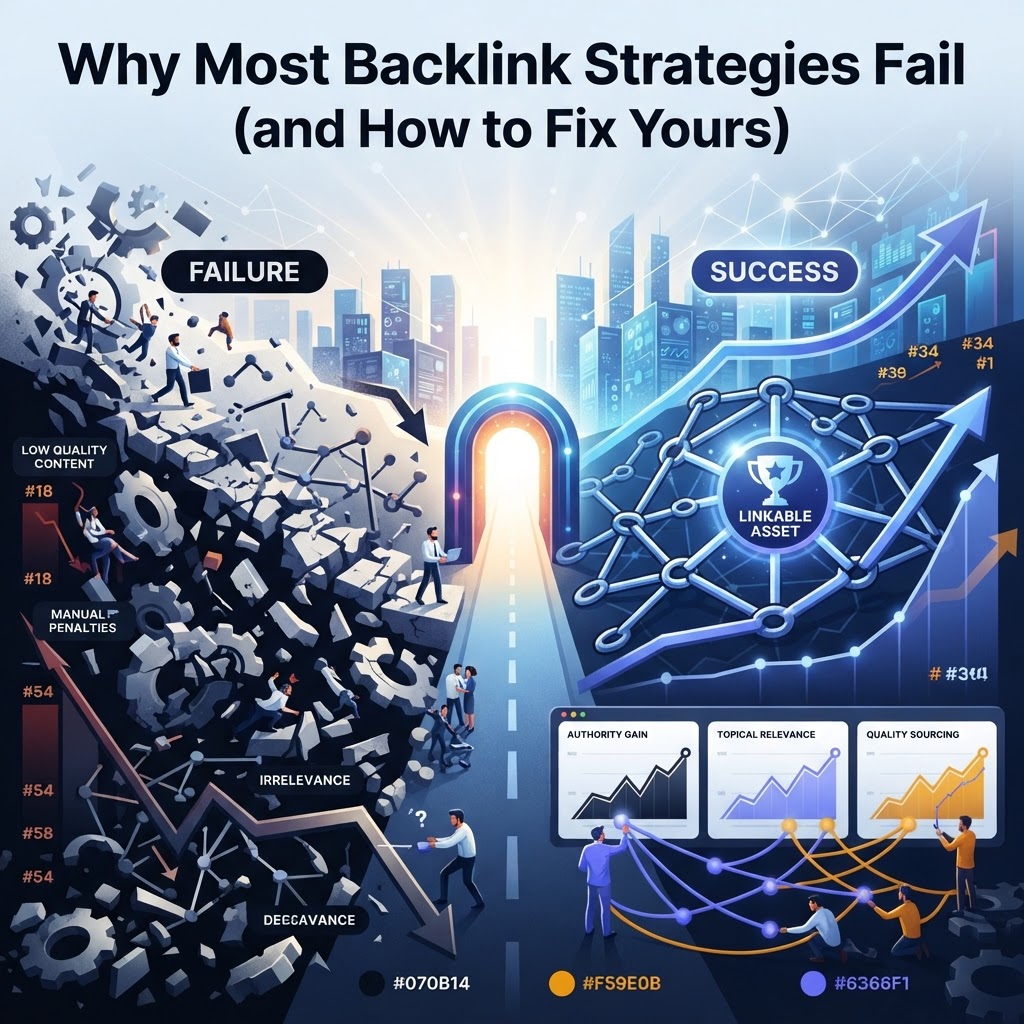
Why Most Backlink Strategies Fail (and How to Fix Yours)
In the world of SEO, backlinks remain the undisputed heavyweight champion of ranking factors. Study after study, including data from Ahrefs and Backlinko, confirms a nearly linear correlation between the number of unique referring domains and a page's search engine position.
Yet, most businesses struggle. They invest thousands of dollars into "link building packages," send hundreds of outreach emails, and watch their Domain Authority (DA) climb—only to see their actual organic traffic remain flat.
If you are building links but not seeing results, you don't have a link problem; you have a strategy problem.
This guide breaks down the fundamental reasons why most backlink strategies fail and provides a definitive framework for building a profile that actually moves the needle.
1. The "DA Trap": Chasing Metrics Over Relevance
The most common reason backlink strategies fail is an obsession with "vanity metrics" like Domain Authority (Moz) or Domain Rating (Ahrefs). While these metrics are useful proxies, they are not used by Google.
The Failure Mode
Many SEOs believe that a link from a DR 80 site is objectively better than a link from a DR 30 site. This leads to "The Spreadsheet Scam," where agencies buy placements on high-DR sites that have zero topical relevance to their niche.
The Fix: Prioritize Topical Relevance
Google’s algorithms, particularly since the advent of BERT and E-E-A-T, prioritize topical relevance. A link from a small, niche-specific blog about "organic gardening" is significantly more valuable to a seed company than a link from a high-authority "general news" site that also covers sports, crypto, and celebrity gossip.
Actionable Strategy: Before acquiring a link, ask three questions:
- Does the linking page cover a subject adjacent to mine?
- Does the linking site’s audience overlap with my target customers?
- Is the "link neighborhood" clean? (Do they link to other reputable sites in my industry?)
2. The Missing "Linkable Asset"
If your outreach strategy consists of asking people to link to your homepage or a commercial service page, you are fighting an uphill battle. No one wants to link to a sales pitch for free.
The Failure Mode
Most strategies fail because they lack a reason to be cited. According to industry data, over 90% of all web content gets zero traffic and zero backlinks. This is usually because the content is generic, "me-too" fluff that adds no new value to the internet.
The Fix: Create High-Leverage Assets
To fix your strategy, you must move from "asking for links" to "earning citations." You need content that other writers want to reference.
Proven Linkable Assets include:
- Original Research & Data: Conduct a survey or analyze industry data. Being the primary source of a statistic is a link magnet.
- Free Tools & Calculators: Interactive utilities (like a mortgage calculator or an SEO audit tool) earn links because they are useful resources.
- Definitive Guides: The "skyscraper" approach—creating the most comprehensive resource on a specific, narrow topic.
- Visual Assets: Infographics, charts, and diagrams that explain complex concepts are frequently embedded by other bloggers.
3. Over-Optimized Anchor Text
In the early days of SEO, you could rank for "best coffee maker" by getting 100 links with the exact anchor text "best coffee maker." Today, that is the fastest way to trigger a manual penalty or an algorithmic filter.
The Failure Mode
SEO teams often try to force exact-match keywords into every guest post or placement. This creates an unnatural backlink profile that screams "manipulation" to Google’s Penguin-era filters.
The Fix: The Natural Distribution Model
A healthy, natural backlink profile should be diverse. If you look at the top-ranking sites in any competitive niche, their anchor text distribution usually looks like this:
- Branded (50-60%): "AAA Backlinks", "aaabacklinks.com"
- Naked URLs (20%): "https://aaabacklinks.com"
- Generic (10%): "click here", "read more", "this study"
- Topic/LSI (5-10%): "link building strategies", "SEO tips"
- Exact Match (<1-3%): Use these sparingly for your most important pages.
4. The "One-and-Done" Outreach Mentality
Link building is not a project; it is a process. Many strategies fail because they are treated as a one-time burst of effort rather than a consistent engine.
The Failure Mode
Sending 500 cold emails in a week and then stopping for three months creates a "link spike" that looks suspicious. Furthermore, cold outreach has a notoriously low conversion rate (often below 1-5%).
The Fix: Relationship-Based Scaling
Instead of transactional link buying, focus on building relationships with editors and journalists. This is where tools and automation can help bridge the gap. While you can manage this manually, using an automated SEO and content engine like AAA Backlinks can help you scale the creation of the high-quality, category-organized blog posts that serve as the foundation for these links.
The "Fix" Framework:
- Identify: Find 50-100 "Power Prospects" in your niche.
- Engage: Follow them on social media, comment on their articles, and provide value before asking for anything.
- Pitch: Offer a unique insight or a data point that improves their existing content.
5. Ignoring the "Link Blackhole"
Sometimes, your strategy fails not because you aren't getting new links, but because you are losing old ones faster than you can replace them.
The Failure Mode
Websites change. Pages get deleted (404 errors), URL structures change without redirects, and partnerships dissolve. If you aren't monitoring your existing profile, you are pouring water into a leaky bucket.
The Fix: Link Reclamation
Use tools like Ahrefs or Semrush to monitor "Lost Backlinks."
- 404 Recovery: If a site is linking to a page on your site that no longer exists, reach out and suggest a new, relevant URL.
- Unlinked Brand Mentions: Use Google Alerts to find people mentioning your brand without a link. A simple, polite email asking for a link is one of the highest-conversion tactics in SEO.
Key Takeaways
- Relevance > Authority: A link from a relevant, low-DR site beats an irrelevant, high-DR site every time.
- Build Assets, Not Just Links: Create original data, tools, or definitive guides that give people a reason to cite you.
- Diversify Anchors: Keep exact-match anchor text to a minimum to avoid penalties.
- Consistency is King: SEO rewards those who show up every month, not those who engage in random bursts of effort.
- Monitor Your Profile: Reclaim lost links and fix 404 errors to maintain your hard-earned authority.
Frequently Asked Questions
Q: How many backlinks do I need to rank on the first page?
A: There is no magic number. It depends entirely on the competition. Analyze the top 3 results for your target keyword; your goal should be to match their link quality and topical relevance, not just their quantity.
Q: Is guest posting dead?
A: No, but "low-quality" guest posting is. Writing for sites that exist only to sell links will hurt you. Writing high-quality, expert content for genuine publications with real traffic remains one of the most effective ways to build authority.
Q: How long does it take for a new backlink to impact my rankings?
A: Generally, it takes 3 to 10 weeks for Google to crawl, index, and re-evaluate your rankings based on new links. Link building is a long-term investment, not an overnight fix.
Tags