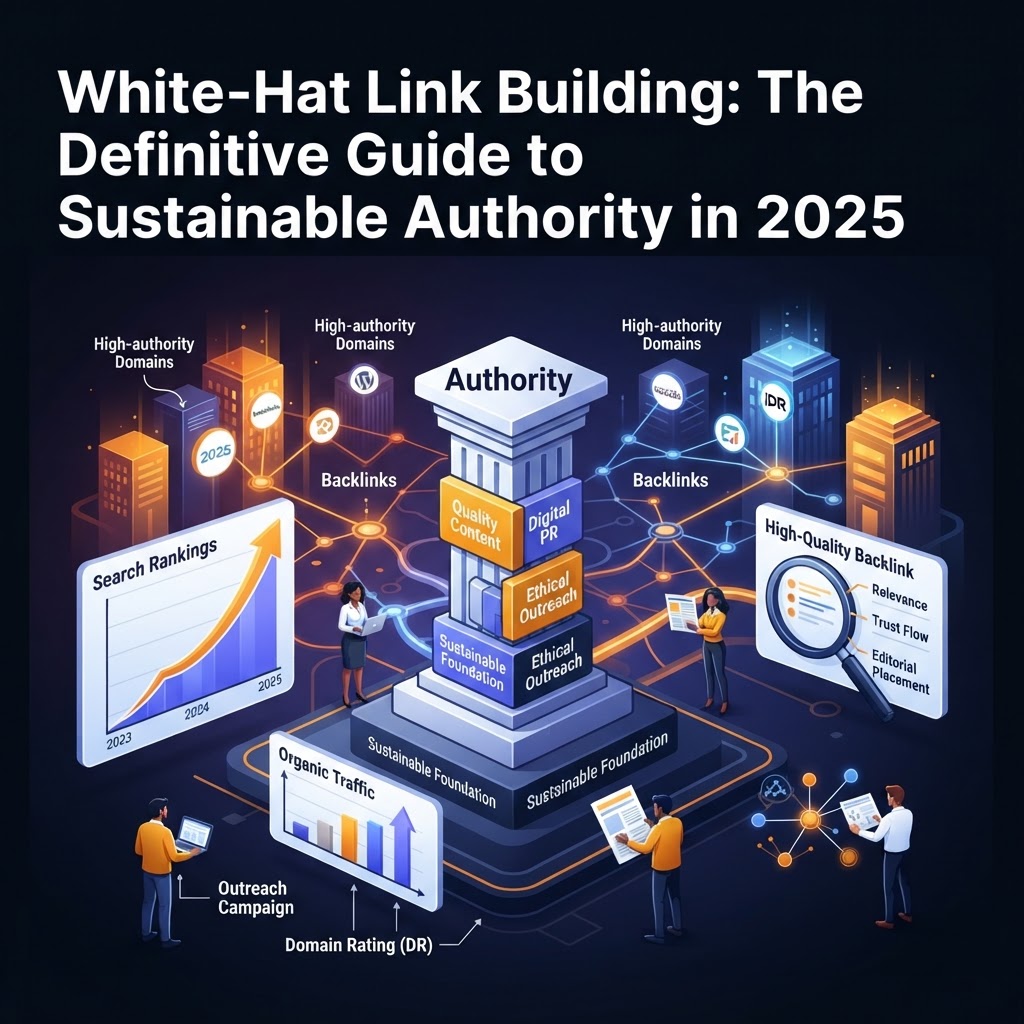
White-Hat Link Building: The Definitive Guide to Sustainable Authority in 2025
Master ethical link building with our comprehensive guide. Learn actionable white-hat strategies to build long-term authority and rank higher in search results.
White-Hat Link Building: The Definitive Guide to Sustainable Authority
In the volatile world of Search Engine Optimization, tactics come and go. One year, it’s scholarship links; the next, it’s automated guest posting. However, as Google’s algorithms—driven by AI and sophisticated spam detection—become increasingly adept at identifying manipulation, the "shortcut" methods of the past are now the fastest way to a manual penalty.
White-hat link building is not just about following the rules; it is about building a digital footprint that deserves to rank. It is the process of earning backlinks through merit, relevance, and genuine value. According to industry data, long-form content earns an average of 77.2% more links than short articles, proving that depth and quality remain the primary drivers of authority.
This guide explores the white-hat strategies that work long-term, helping you build a backlink profile that survives algorithm updates and drives sustainable organic growth.
The Core Philosophy: E-E-A-T and Linkability
Before diving into tactics, we must understand why a site links to another. In a white-hat context, a link is an editorial vote of confidence. Google uses these votes to assess your site’s Experience, Expertise, Authoritativeness, and Trustworthiness (E-E-A-T).
To earn these votes, your content must be "linkable." A linkable asset is a piece of content so valuable, unique, or comprehensive that other creators feel compelled to reference it. Without a linkable asset, outreach is just spam.
1. The Power of Original Data and Industry Reports
One of the most effective ways to earn high-authority links is to become the primary source of information. Journalists and bloggers are always looking for statistics to back up their claims.
How to Execute:
- Conduct Surveys: Use your email list or social media following to gather unique insights about your industry.
- Analyze Public Data: Take existing datasets (from government sites or industry repositories) and find a new angle or visualization.
- Publish a "State of the Industry" Report: Annual reports become "living" documents that earn links year after year as they are updated.
Real-World Example: A SaaS company in the HR space might survey 1,000 remote workers about burnout. The resulting "2025 Remote Work Burnout Report" becomes a citable source for major news outlets like Forbes or Business Insider.
2. The Skyscraper Technique 2.0
Popularized by Brian Dean, the Skyscraper Technique involves finding content that already has links, creating something better, and reaching out to the same people. In 2025, "better" doesn't just mean "longer." It means more useful.
The Three-Step Process:
- Step 1: Find a piece of content in your niche that has a high volume of referring domains (use tools like Ahrefs, Semrush, or the AAA Backlinks analyzer to identify these opportunities).
- Step 2: Create a superior version. Add custom illustrations, updated data, expert quotes, or a more intuitive user interface.
- Step 3: Reach out to the sites linking to the original piece. Inform them that you’ve created a more comprehensive or updated resource that their readers might find valuable.
3. Digital PR and Expert Commentary
Digital PR is the intersection of traditional public relations and SEO. Instead of just "building links," you are building a brand. The most common entry point for this is Connectively (formerly HARO) or Featured.com.
Actionable Strategy:
- Monitor Queries: Set up alerts for journalists looking for experts in your field.
- Provide Immediate Value: When responding, don't just offer an interview. Provide a 2-3 paragraph quote that the journalist can copy and paste directly into their article.
- Be First: Journalists often receive hundreds of pitches. Responding within the first hour significantly increases your success rate.
4. Broken Link Building: The "Value-First" Outreach
Broken link building is a classic white-hat tactic because it helps webmasters fix their own sites. You are identifying a "404 error" on their page and offering your own content as a replacement.
The Workflow:
- Find a dead page in your niche that used to have many links (check competitor 404 pages).
- Recreate the content (or use an existing post that covers the topic).
- Email the site owner: "I was reading your article on [Topic] and noticed the link to [Dead Resource] is broken. I actually wrote a comprehensive guide on that same topic recently—might be a good replacement to keep the page helpful for your readers!"
5. Reclaiming Unlinked Brand Mentions
If someone mentions your brand but doesn't link to you, they are already a fan. This is the lowest-hanging fruit in link building.
How to Automate This:
- Use Google Alerts or Brand24 to monitor mentions of your company name, your founders, or your proprietary products.
- When a mention appears without a link, send a polite email: "Thanks for the shout-out in your recent post! Would you mind making that a clickable link so your readers can easily find us?"
Scaling Your Strategy Ethically
Link building is time-consuming. Many agencies struggle to balance quality with the need for volume. This is where strategic automation comes in. Tools like AAA Backlinks can help agencies manage multiple campaigns and transform existing URLs into link-worthy blog posts, ensuring that the foundation of your outreach—the content—remains high-quality while you scale your efforts.
Quality Metrics to Track:
- Domain Rating (DR) / Domain Authority (DA): While not official Google metrics, they help gauge a site's relative power.
- Topical Relevance: A link from a small blog in your specific niche is often more valuable than a link from a large, unrelated news site.
- Organic Traffic: Ensure the site linking to you actually has its own audience. A site with zero traffic is often a "link farm."
Key Takeaways
- Focus on Value: If your content doesn't help the user, it doesn't deserve a link.
- Diversify Tactics: Don't rely solely on guest posting or HARO. A healthy backlink profile uses a mix of strategies.
- Think Long-Term: White-hat SEO is a marathon. The links you earn today through original research will still be passing authority five years from now.
- Prioritize Relevance: A link from a relevant industry peer carries more weight than a generic high-authority link.
Frequently Asked Questions (FAQ)
1. How long does it take to see results from white-hat link building?
Typically, it takes 3 to 6 months to see a significant impact on rankings. Unlike black-hat methods that may show instant (but temporary) spikes, white-hat links build a foundation of trust that compounds over time.
2. Is guest posting still considered "white-hat"?
Yes, provided it is done for the purpose of reaching a new audience and sharing expertise. It becomes "gray-hat" or "black-hat" when you use low-quality content, exact-match anchor text, and post on sites that exist only to sell links.
3. How many backlinks do I need to rank on the first page?
There is no magic number. It depends entirely on the competition for your target keyword. Instead of focusing on quantity, focus on acquiring links from sites that have higher authority and better topical relevance than the current top-ranking pages.
Tags