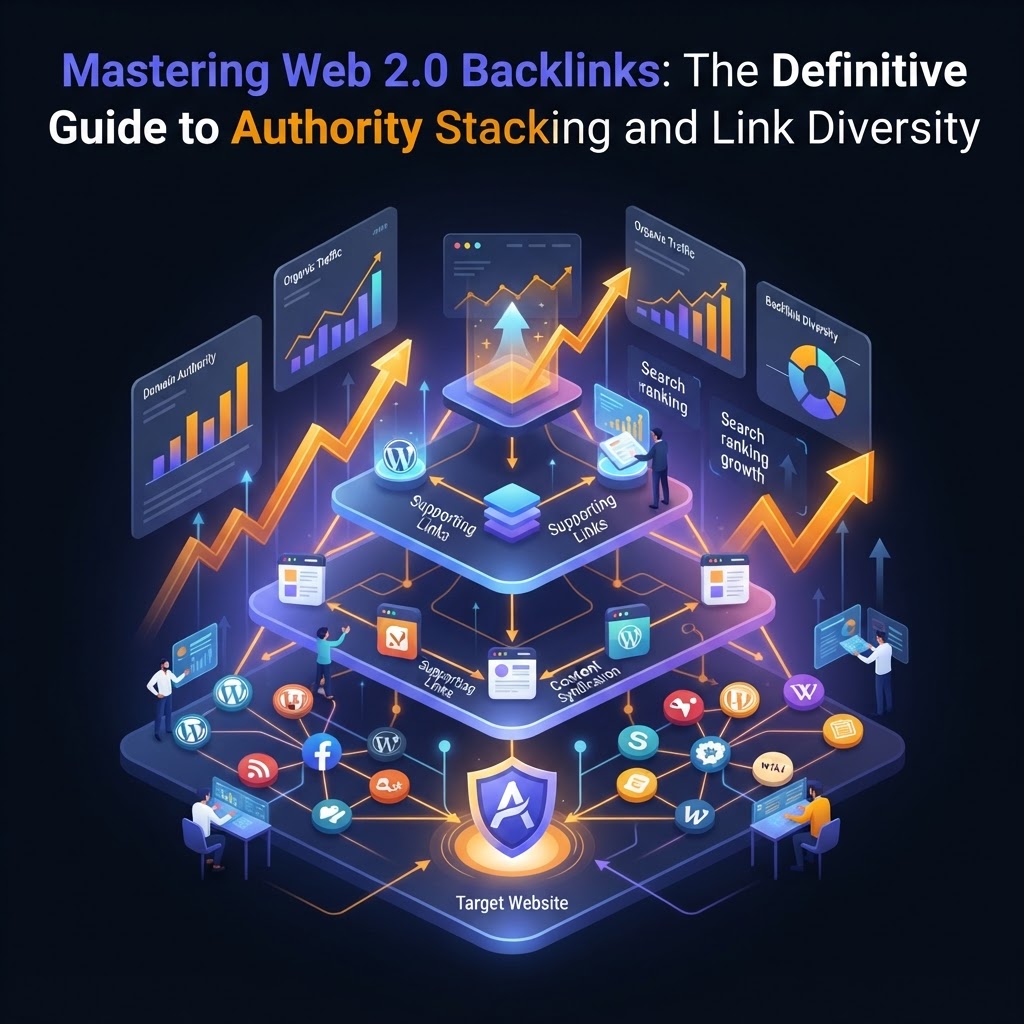
Mastering Web 2.0 Backlinks: The Definitive Guide to Authority Stacking and Link Diversity
Learn how to safely leverage Web 2.0 properties for SEO. This guide covers advanced strategies, footprint avoidance, and how to build high-authority backlinks.
Mastering Web 2.0 Backlinks: The Definitive Guide to Authority Stacking and Link Diversity
In the early days of SEO, link building was often a numbers game. Today, search engines like Google have evolved to prioritize relevance, authority, and user intent. Amidst these changes, one strategy has remained a staple for SEO professionals: Web 2.0 link building.
When executed correctly, Web 2.0 properties allow you to build a "buffer" of authority around your main website, diversifying your link profile and providing contextual relevance that is difficult to achieve through other means. However, the line between a high-authority asset and a spammy footprint is thin.
This guide will walk you through the mechanics of leveraging Web 2.0 properties for backlinks, moving beyond basic tactics to advanced strategies that drive sustainable rankings.
What Are Web 2.0 Properties?
Web 2.0 properties are platforms that allow users to create and host their own content for free. Unlike the static "read-only" web of the 1990s, Web 2.0 is defined by user-generated content and interaction. Popular examples include WordPress.com, Blogger, Tumblr, Medium, and Wix.
From an SEO perspective, these platforms are goldmines because they possess high Domain Authority (DA). When you create a sub-domain on these sites (e.g., yourniche.wordpress.com), you are essentially borrowing a portion of that platform's established trust to pass on to your own site via backlinks "How To Use Web 2.0 Sites for Backlinks: A Complete SEO Guide | Hannah Hording".
Why Web 2.0s Still Matter in Modern SEO
Despite the rise of AI-driven search and complex algorithm updates, backlinks remain one of the top three ranking factors in Google's ecosystem. Web 2.0s offer several unique advantages:
- Complete Control: Unlike guest posting, where an editor controls your anchor text and link placement, you have 100% control over the content on a Web 2.0 property "How To Use Web 2.0 Sites for Backlinks: A Complete SEO Guide | Hannah Hording".
- Cost-Effectiveness: Most of these platforms are free to use, making them an accessible entry point for startups and small businesses "About How To Create Web 2.0 Backlinks".
- Link Diversity: A natural backlink profile includes various link types (blogs, forums, news, social). Web 2.0s help round out this profile "How To Use Web 2.0 Sites for Backlinks: A Complete SEO Guide | Hannah Hording".
- Topical Authority: By creating a mini-network of sites dedicated to your niche, you signal to search engines that your primary site is a central hub for that specific topic.
The Anatomy of a High-Quality Web 2.0 Property
The biggest mistake SEOs make is treating Web 2.0s as "disposable" sites. To Google, a site with one 300-word article and a single outbound link looks like spam. To build a property that actually passes authority, it must look like a legitimate, living blog.
1. Platform Selection
Choose platforms that are active and have a history of indexing well.
- High Authority: WordPress.com, Blogger (Google-owned), Tumblr.
- Niche-Specific: Medium (for thought leadership), Wix or Weebly (for business-style layouts).
- Visual-Heavy: Pinterest or Behance (if your niche is design-oriented) "How Web 2.0 Blog Backlinks Improve SEO".
2. Content Strategy
Content is the heartbeat of a Web 2.0 property. Aim for "Value-First" content rather than "Link-First" content.
- Length: Aim for 500–1,000 words per post "Web 2.0 Links in 2025: Still Effective or SEO Myth?".
- Multimedia: Include original images, embedded YouTube videos, and infographics to increase engagement signals "How To Use Web 2.0 Sites for Backlinks: A Complete SEO Guide | Hannah Hording".
- Relevance: If your main site is about "Organic Gardening," your Web 2.0 should not be about "Crypto Trading." Keep the topical relevance tight "How To Use Web 2.0 Sites For Backlinks".
Step-by-Step: How to Build Web 2.0 Backlinks Safely
Step 1: Setup and Persona Creation
Do not use the same email address or username for every platform. This creates a "footprint" that search engines can easily track. Use different personas and, if possible, different IP addresses (via a VPN) when creating accounts.
Step 2: The "Warm-Up" Phase
Do not link to your main site (your "Money Site") in the very first post.
- Post 1: A general introductory post about the topic with no outbound links.
- Post 2: An informative guide that links to high-authority, non-competing sites (like Wikipedia or a major news outlet).
- Post 3: This is where you introduce your backlink.
Step 3: Strategic Link Placement
When you finally add your link, ensure the anchor text is natural. Avoid over-optimizing with exact-match keywords. Instead, use a mix of:
- Branded Anchors: "According to [Your Brand Name]..."
- Naked URLs: "Visit https://yoursite.com for more info."
- Partial Match: "This guide on [organic soil types] explains..."
For agencies managing high-volume campaigns, scaling this process manually can be difficult. Tools like AAA Backlinks can help automate the content engine, transforming URLs into high-quality, category-organized blog posts while maintaining the necessary quality standards "AAA Backlinks".
Advanced Strategies: Link Wheels and Pyramids
To maximize the power of Web 2.0s, you can organize them into structures that amplify their authority.
The Web 2.0 Link Wheel
In a link wheel, you create multiple Web 2.0 properties (Site A, B, C, D). Site A links to Site B, Site B links to Site C, and so on, until the circle is closed. Each site also links back to your Money Site. This creates a closed loop of authority.
- Warning: Modern algorithms are good at detecting perfect wheels. It is safer to leave the wheel "open" (Site A links to B, but D does not link back to A) to appear more natural "The Complete Guide to Web 2.0 Link Building: Link Wheels, Pyramids, and Backlink Strategies".
The Tiered Link Pyramid
This is a more robust strategy where you build links to your Web 2.0 properties.
- Tier 1: High-quality Web 2.0s linking directly to your Money Site.
- Tier 2: Social bookmarks, forum profiles, or lower-quality Web 2.0s linking to your Tier 1 properties. This passes authority up the chain, making your Tier 1 links significantly more powerful without risking your main site's safety "The Complete Guide to Web 2.0 Link Building: Link Wheels, Pyramids, and Backlink Strategies".
Avoiding the "Spam" Trap: Common Pitfalls
- Duplicate Content: Never copy-paste the same article across multiple Web 2.0s. Google will filter these out, and they will provide zero SEO value "How To Use Web 2.0 Sites for Backlinks: A Complete SEO Guide | Hannah Hording".
- Neglecting the Property: A site that hasn't been updated in two years loses its "freshness" signal. Aim to post new content at least once every few months to keep the property active "How To Use Web 2.0 Sites For Backlinks".
- Over-Linking: Don't put five links to your site in one 500-word article. One or two well-placed links are sufficient "Web 2.0 Links in 2025: Still Effective or SEO Myth?".
Key Takeaways
- Quality Over Quantity: One well-maintained Web 2.0 with multiple posts and images is worth more than 50 thin, one-page sites.
- Diversify Platforms: Use a mix of WordPress, Blogger, and Medium to avoid platform-specific footprints.
- Control the Narrative: Use Web 2.0s to build topical relevance around your most important keywords.
- Stay Natural: Vary your anchor text and avoid linking to your money site in every single post.
Frequently Asked Questions (FAQ)
Q1: Are Web 2.0 backlinks Dofollow or Nofollow? Most major platforms like WordPress and Blogger provide Dofollow links, which pass link equity. However, some platforms like Medium default to Nofollow. Both are valuable for a natural link profile "How To Use Web 2.0 Sites For Backlinks".
Q2: How many Web 2.0 properties should I build? There is no magic number, but for a new site, starting with 5–10 high-quality properties is a safe way to build initial authority. Focus on making these 10 sites look as real as possible before scaling further.
Q3: Can Web 2.0s get my site penalized? Only if they are used recklessly. If you use automated software to blast thousands of low-quality, spun-content links, you risk a manual action. If you create high-quality, manual properties with unique content, they are a safe and effective SEO tactic "About How To Create Web 2.0 Backlinks".
Tags