Mastering Position Zero: The Definitive Guide to Featured Snippet Optimization
Learn how to capture Google's featured snippets and win Position Zero. This expert guide covers content structuring, HTML formatting, and AI search strategies.
Mastering Position Zero: The Definitive Guide to Featured Snippet Optimization
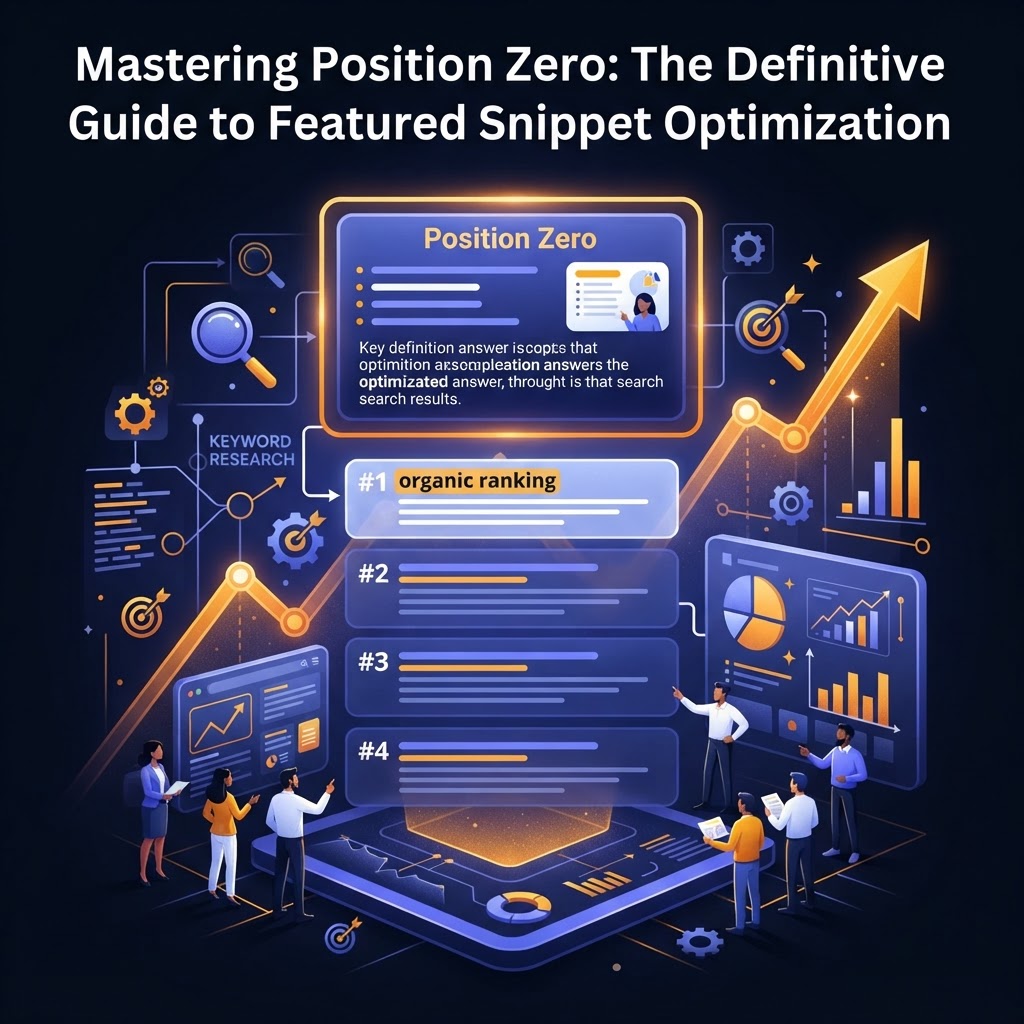
In the modern search landscape, ranking #1 is no longer the ultimate goal. The real prize is "Position Zero"—the Featured Snippet.
Featured snippets are the highlighted boxes that appear at the top of Google’s search results, providing users with a quick, direct answer to their query. According to industry research, approximately 12.3% of search queries now trigger a featured snippet, and these results capture roughly 8.6% of all clicks on the page (Ahrefs).
Capturing a snippet doesn't just drive traffic; it establishes your brand as the definitive authority on a topic. This guide will walk you through the exact strategies needed to identify snippet opportunities and restructure your content to win them.
The Four Main Types of Featured Snippets
Before you can optimize, you must understand what Google is looking for. Snippets generally fall into four categories:
- Paragraph Snippets: The most common format, usually appearing for "what is," "why," or "who" queries. Google extracts a 40–60 word block of text to answer the user's question directly (Digital Applied).
- List Snippets (Ordered & Unordered): These appear for "how-to" guides, recipes, or "best of" lists. Google uses your H2 or H3 headings or HTML list tags (
<ul>or<ol>) to generate these. - Table Snippets: Used for comparisons, pricing, and data sets. Google prefers well-structured HTML
<table>elements for these results. - Video Snippets: Often pulled from YouTube for tutorial-based queries, showing a specific timestamp that answers the user's question (American Eagle).
Step 1: Identify "Low-Hanging Fruit" Opportunities
You don't need to rank #1 to win a featured snippet, but you generally need to be on the first page. Research shows that 99.58% of featured snippets are pulled from pages already ranking in the top 10 (Ahrefs).
How to find opportunities:
- Filter for existing rankings: Use tools like Ahrefs or Semrush to find keywords where you rank in positions 2–10 that already have a featured snippet owned by a competitor.
- Analyze the current winner: Look at the snippet Google is currently displaying. Is it a paragraph? A list? A table? Your goal is to provide a better version of that specific format.
- Target informational intent: Focus on long-tail keywords and question-based queries (e.g., "how to calculate ROI" vs. "ROI calculator").
Step 2: The "Snippet Bait" Content Structure
Google’s algorithm is designed to extract information efficiently. To help it, you should use a technique often called "Snippet Bait." This involves placing a concise, perfectly formatted answer to a specific question at the top of a section.
The Paragraph Formula
If you are targeting a paragraph snippet, follow this structure:
- The Heading: Use an H2 or H3 that mirrors the user's question (e.g., "What is a Backlink?").
- The Answer: Immediately follow the heading with a 40–60 word paragraph that starts with a direct definition (e.g., "A backlink is a link from one website to another...").
- The Context: Follow the answer with more in-depth information to satisfy the user if they click through.
The List Formula
For "how-to" or "types of" queries:
- Use a clear, descriptive H2 heading.
- Use H3s for each step or item, or use a clean HTML bulleted/numbered list.
- Keep each list item concise and action-oriented.
Step 3: Technical Optimization and Semantic HTML
Google relies on your code to understand the structure of your data. If your HTML is messy, your chances of winning a snippet drop significantly.
- Use Semantic Tags: Ensure your headers follow a logical hierarchy (H1 > H2 > H3). Never skip levels.
- Clean Table Markup: If you are presenting data, use the
<table>,<tr>, and<td>tags. Avoid using CSS to make a list look like a table; Google needs the actual HTML structure to parse it correctly (Search Engine Land). - Schema Markup: While not a direct requirement for featured snippets, using
FAQorHowToschema can help Google understand the intent of your content more clearly.
Step 4: Featured Snippets in the Age of AI Overviews (SGE)
As of 2026, Google’s AI Overviews (formerly SGE) appear on approximately 58% of queries, often sitting above or replacing traditional featured snippets (Digital Applied).
However, the strategies for winning both are remarkably similar. AI Overviews often cite the same sources that win featured snippets. To optimize for both:
- Prioritize Accuracy: AI models and snippet algorithms both favor factual, data-backed content. Cite your sources clearly.
- Demonstrate E-E-A-T: Ensure your author bio and site authority signals are strong. Google is more likely to feature content from a "trusted" source.
- Scale with Quality: If you are managing multiple campaigns, tools like AAA Backlinks can help you scale content production, but you must ensure each piece is manually refined to include these snippet-optimized structures.
Common Mistakes to Avoid
- Burying the Lead: Don't write a long introduction before answering the question. Google wants the answer immediately following the relevant heading.
- Being Too Wordy: If your answer is 100 words long, Google will likely truncate it or choose a competitor who was more concise.
- Ignoring Visuals: For many queries, Google will pair your text snippet with an image from your page. Ensure your images have descriptive alt text that matches the query.
Key Takeaways
- Target Top 10 Rankings: You must be on page one to realistically compete for Position Zero.
- Match the Format: If the current snippet is a table, optimize your content into a table.
- The 40-60 Word Rule: Keep paragraph answers concise and direct.
- Use Question Headings: Structure your H2s and H3s as the questions users are actually typing into search.
- Monitor and Iterate: Snippets are volatile. If you lose one, analyze the new winner and adjust your content to be even more helpful.
Frequently Asked Questions
1. Does winning a featured snippet hurt my CTR?
While some "zero-click" searches occur because the user gets the answer on the SERP, studies show that featured snippets generally increase CTR for the winning site by providing massive visibility and authority, especially for complex topics that require a click for full context.
2. Can I use Schema markup to get a featured snippet?
Schema markup (like FAQSchema) helps Google understand your content, but it does not guarantee a featured snippet. Snippets are pulled from the visible on-page content, not the hidden code.
3. How long does it take to win a featured snippet?
If you already rank in the top 10, you can often win a snippet within days of updating and re-indexing your content. It is one of the fastest ways to see an SEO impact without building new backlinks.
Tags