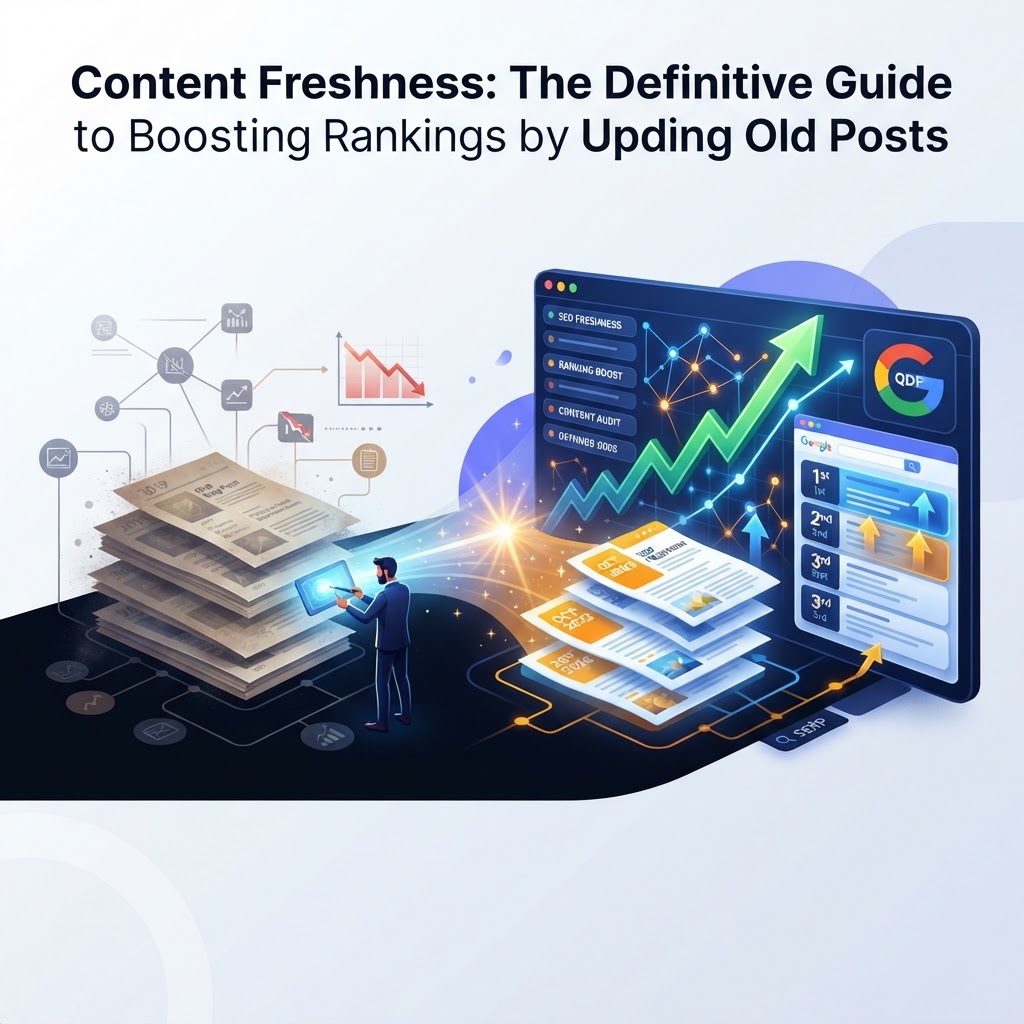
Content Freshness: The Definitive Guide to Boosting Rankings by Updating Old Posts
Learn why content freshness is a critical ranking factor. Discover data-backed strategies to refresh old posts, stop content decay, and boost organic traffic by 106%.
Content Freshness: The Definitive Guide to Boosting Rankings by Updating Old Posts
In the world of SEO, there is a common misconception that the path to growth is paved solely with new URLs. Content teams often find themselves on a "treadmill," churning out three to five new articles a week while their older, once-successful posts slowly sink into the depths of the Search Engine Results Pages (SERPs).
This phenomenon is known as content decay.
Data shows that refreshing existing content is often more effective than publishing new material. According to industry studies, updating and republishing old blog posts can increase monthly organic search views by an average of 106%. Furthermore, in the age of Generative AI, fresh content is cited 25.7% more often by AI models like ChatGPT and Perplexity.
This guide will explore the mechanics of content freshness, why Google prioritizes it, and how you can implement a systematic refresh strategy to reclaim lost traffic.
What is Content Freshness in SEO?
Content freshness refers to how recently a webpage was published or significantly updated. However, it is not a binary "yes/no" factor. Google views freshness through the lens of the user’s intent.
The QDF (Query Deserves Freshness) Factor
Google uses a mathematical model to determine if a specific search query requires the most up-to-date information. This is known as Query Deserves Freshness (QDF).
QDF typically triggers for three types of queries:
- Recent Events: Breaking news or trending topics (e.g., "election results").
- Regularly Recurring Events: Annual events or reports (e.g., "best laptops 2025").
- Frequent Updates: Topics where information changes rapidly (e.g., "SEO best practices" or "software reviews").
For evergreen topics, like "how to tie a tie," freshness matters less. But for competitive commercial and educational keywords, a post from three years ago—no matter how well-written—is often viewed as a liability by search algorithms.
Why Updating Old Posts Boosts Rankings
Updating content isn't just about changing a date in your CMS. It works because it addresses several key SEO pillars simultaneously:
1. Improved Click-Through Rate (CTR)
Searchers are naturally drawn to recent dates in the SERPs. A study by The Blu Group notes that updating a title tag from "2023 Trends" to "2025 Trends" can significantly increase CTR. Higher CTR signals to Google that your result is the most relevant, which can lead to a permanent ranking boost.
2. Elimination of Content Decay
Content decay happens when a post’s traffic peaks and then steadily declines. This usually occurs because competitors have published more current information or the original stats and links have become obsolete. Refreshing the post "resets" the decay curve.
3. Enhanced E-E-A-T
Google’s Search Quality Rater Guidelines emphasize Experience, Expertise, Authoritativeness, and Trustworthiness (E-E-A-T). Outdated information, broken links, and old statistics erode trust. By keeping content current, you signal to both users and search engines that your site is a reliable, authoritative resource.
4. Increased Crawl Frequency
Googlebot prioritizes sites that change frequently. When you update old content, you signal to Google that your site is active, which can lead to more frequent crawling and faster indexing of your entire domain.
How to Identify Which Posts to Refresh
You shouldn't update every post on your site. To maximize ROI, focus on pages that already have "potential energy."
- The "Striking Distance" Posts: Use a tool like Google Search Console to find pages ranking in positions 11–25. These pages are on the cusp of page one; a freshness boost is often all they need to break into the top 10.
- High-Traffic/High-Decay Posts: Identify pages that were top traffic drivers a year ago but have seen a 20% or greater drop in sessions.
- High-Authority Pages: Look for pages with a high number of backlinks. While tools like AAA Backlinks can help you identify which pages have the strongest link profiles to prioritize, the goal is to ensure that the content living on those high-authority URLs remains top-tier.
The Step-by-Step Content Refresh Playbook
To see a ranking boost, your updates must be substantive. Simply changing the "Published Date" without altering the body text is a "hack" that Google’s John Mueller has explicitly warned against, stating it does not make a site great.
Step 1: Update Factual Information and Stats
Replace any statistics older than two years with current data. If you cited a study from 2019, find the 2024 or 2025 version. This is one of the strongest signals of freshness.
Step 2: Fix Broken Links and Improve Internal Linking
Check all external links. If a source you linked to is now a 404 page, replace it. Additionally, add internal links to newer content you’ve published since the original post went live. This helps distribute "link juice" and improves site architecture.
Step 3: Optimize for "People Also Ask" (PAA)
Look at the current SERP for your target keyword. What questions are appearing in the PAA box? Add a new H3 section to your post that directly answers one or two of these questions. This increases your chances of winning featured snippets.
Step 4: Improve User Experience (UX) and Media
- Add Video: Embedding a relevant YouTube video can increase dwell time, a positive user signal.
- Update Images: Replace grainy or outdated screenshots with high-definition visuals.
- Above the Fold: Ensure the answer to the user's query is visible above the fold to reduce bounce rates.
Step 5: Refresh the Meta Data
Rewrite your meta description to be more compelling. If the year is part of the title, ensure it is updated to the current year.
Common Pitfalls to Avoid
- Changing the URL: Unless the original URL is poorly structured, do not change it. Changing the URL requires a 301 redirect, which can lead to a temporary loss in ranking power.
- Over-Optimizing: Don't just stuff more keywords into the old post. Focus on search intent and readability.
- Ignoring Search Intent Shifts: Sometimes a keyword that used to be "informational" becomes "transactional." If the SERP has changed entirely, a simple refresh won't work; you may need a full rewrite.
Key Takeaways
- Freshness is a Ranking Factor: Especially for QDF (Query Deserves Freshness) topics where users need current info.
- Substance Over Syntax: Google rewards meaningful updates (new data, new sections, better UX), not just date changes.
- Prioritize Striking Distance: Focus your efforts on posts ranking on page two or those with significant existing backlinks.
- AI Visibility: Keeping content fresh is the best way to ensure your site is cited by AI search engines and LLMs.
FAQ
Q: How often should I update my blog posts?
A: For high-competition keywords, a 90-to-120-day review cycle is ideal for posts in positions 11–25. Evergreen content can typically be reviewed once per year.
Q: Should I change the "Published Date" or use a "Last Updated" date?
A: It is best practice to display a "Last Updated" date. This provides transparency to the user and signals freshness to search engines without erasing the original history of the post.
Q: Does deleting old content help SEO?
A: Only if the content is "thin" or has zero traffic and no backlinks. In most cases, it is better to consolidate two weak posts into one comprehensive, fresh guide or to redirect the old post to a more relevant page.
Tags